I love Aqaba! If I had it my way, we’d be living happily ever after (at least until we leave and return to DC) in Aqaba. Aqaba is about a three-hour drive south of Amman, but it feels like a world of difference. Perhaps the Red Sea is what makes it so spectacular, or maybe the ocean relieves the monotony of the vistas, unlike in Amman where I experience sensory deprivation from the lack of color in this monochromatic landscape.
The Kempinski
We were in Aqaba for just two nights. We didn’t really even do much other than eat, work out, and lay out. It wasn’t very warm, only about 65 degrees (F), but with the sun and the view, it felt heavenly as a relief from the crummy and cold weather in Amman. I cannot wait to return in just a few weeks for another two nights!
Finding things to do and places to visit in Jordan on the weekends is becoming more and more tedious as we knock things off the list. We’ve already hit the major tourist sites, scoured the guide-book, and are now left to our own devices and suggestions from others for things to do. Luckily for us, a tour of an olive oil plant was offered so we took advantage of the opportunity. (In case you didn’t know (I didn’t), Jordan is known for its olive oil. Olive trees are everywhere here and are the known as the oldest trees in the world. We often see people collecting olives from the trees in the neighborhoods).
Had we not been part of a caravan to the factory, we would have passed it by, as we’ve already done on numerous occasions. The exterior of the factory is unassuming, like most buildings here, but once we entered, I was surprised to see such a large operation. We went on a brief tour of the factory, sampled a couple different types of olive oil, grabbed a snack, and then bought a few things in the gift shop.
[FYI: The name of the factory is Terra Rossa, or ‘Red Soil,’ named for the indigenous type of red clay soil produced by the weathering of limestone. Compared to most clay soils, terra rossa has good drainage characteristics making it a popular soil type for olive and wine production. The main types of olives used for the production of olive oil in Jordan are Nabali, Improved Nabali, Souri, and Roman.]
The process for olive milling (or pressing) is as follows:
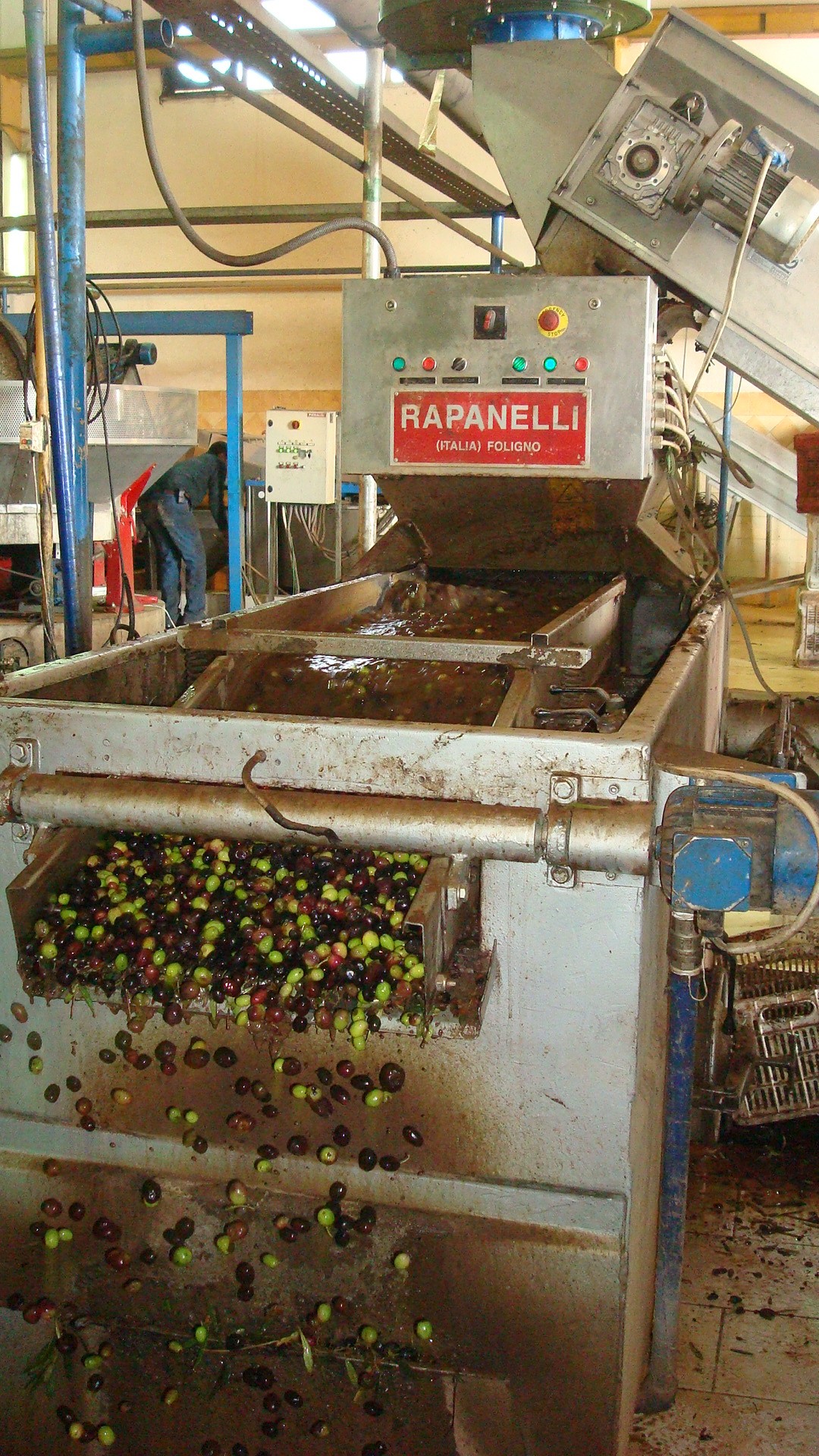
Olives being fed into the machine to be washedOlives moving up into the machine to be washedWashing the olives
1. Washing: The first step is to clean the olives, removing stems, leaves, twigs, and other debris left with the olives.
Grinding the olives with a millstone
2. Crushing: The olives are ground into a paste with a millstone to tear the flesh cells of the olive to facilitate the release of the oil from the olives.
Malaxing the paste
3. Malaxing: Mixing the crushed olive paste.
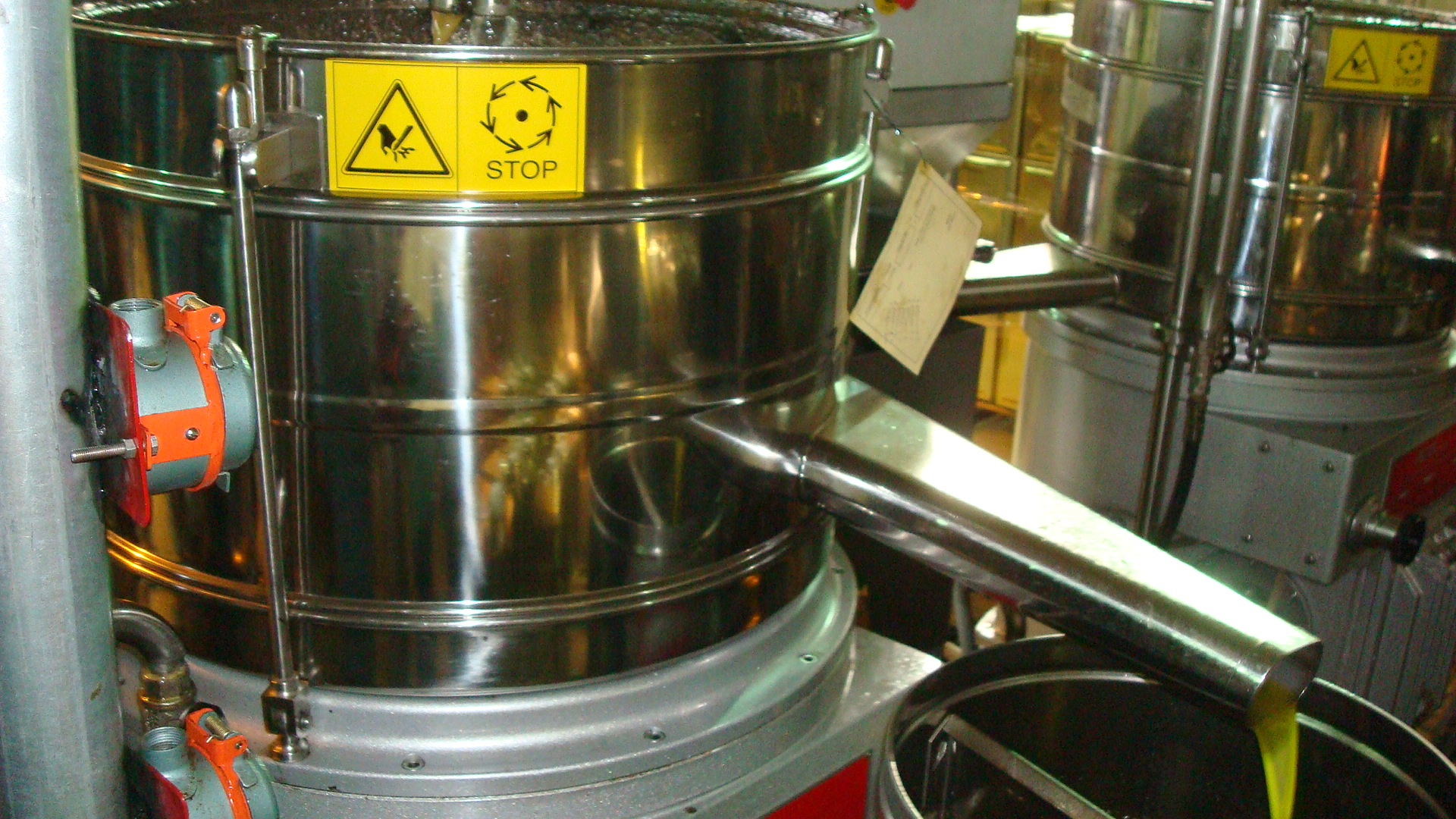
Separating the oil from the vegetable water and solid
4. Separation of oil from vegetable water and solid (done through centrifugation)
Huge canisters of olive oil ready for deliveryOlive pomace, the waste product of the industry (but it can be used for cooking if and heating if it's made into briquette logs.)In front of an old millstone
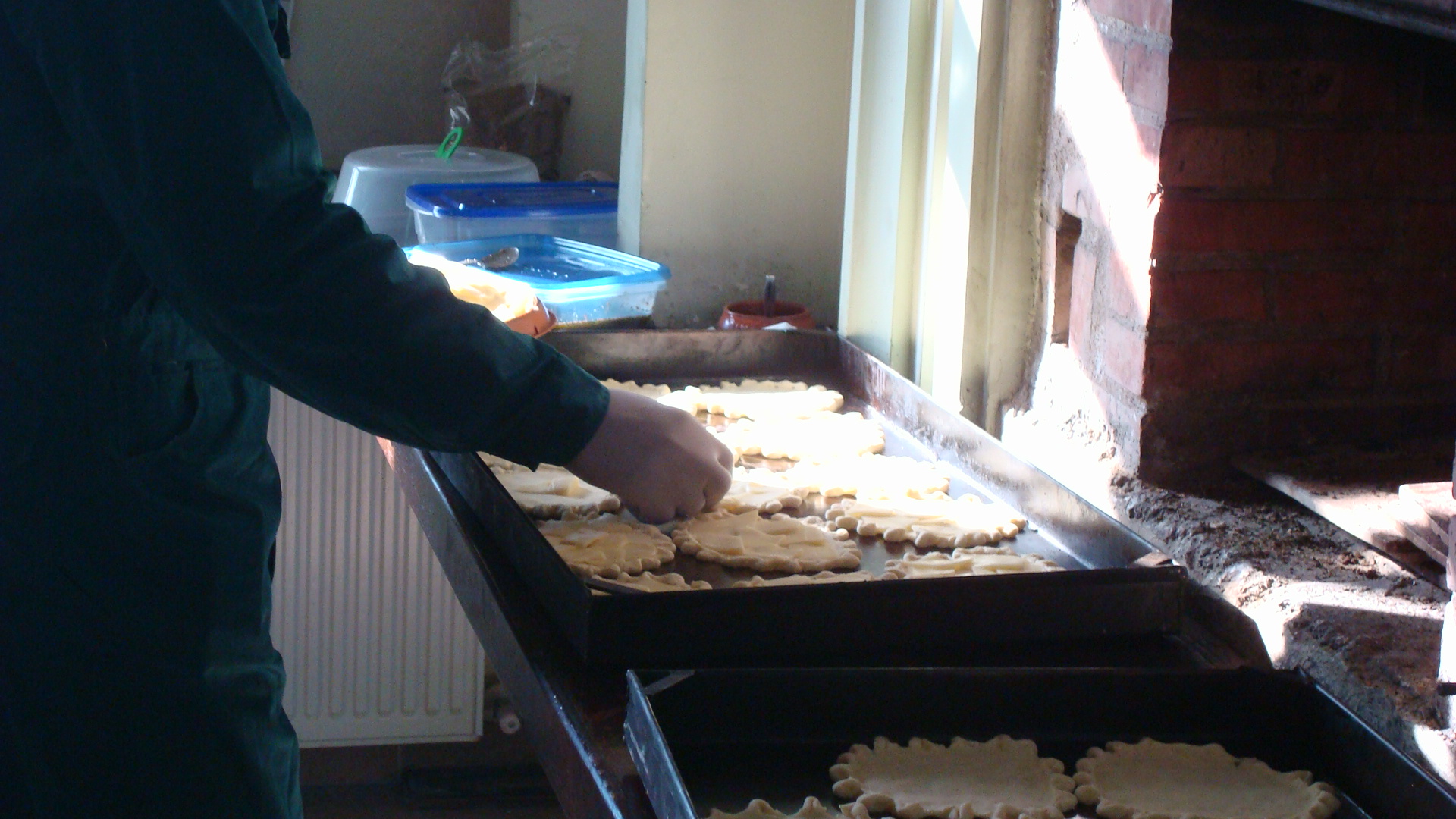
After the tour we tasted a couple of olive oil samples and then were treated to manaeesh (dough topped with za’atar (thyme with sesame seeds and olive oil) or cheese), which were cooked over an open fire of olive pomace logs.
Preparing manaeesh
After our snack and tea, we made it to the gift shop to purchase a few bottles of sinolea olive oil and a couple of terra-cotta serving bowls to accompany the oil. I haven’t tried cooking with this gold standard of olive oil (and we’ll have to keep it in the food safe with our honey from Yemen), but I’ll let you know if I can detect any difference and if it’s worth it. 🙂
Store shelves lined in oilsThe purchases...
[FYI: Sinolea is a method used to extract oil from the olives. Extra virgin olive oil extracted from this method is said to be the “flower of the oil” as there is minimal interference in the extraction of the oil because no heat is applied. In this method of extraction, polyphenols (the good for you stuff in EVOO) are concentrated 3X more than in regular EVOO.]
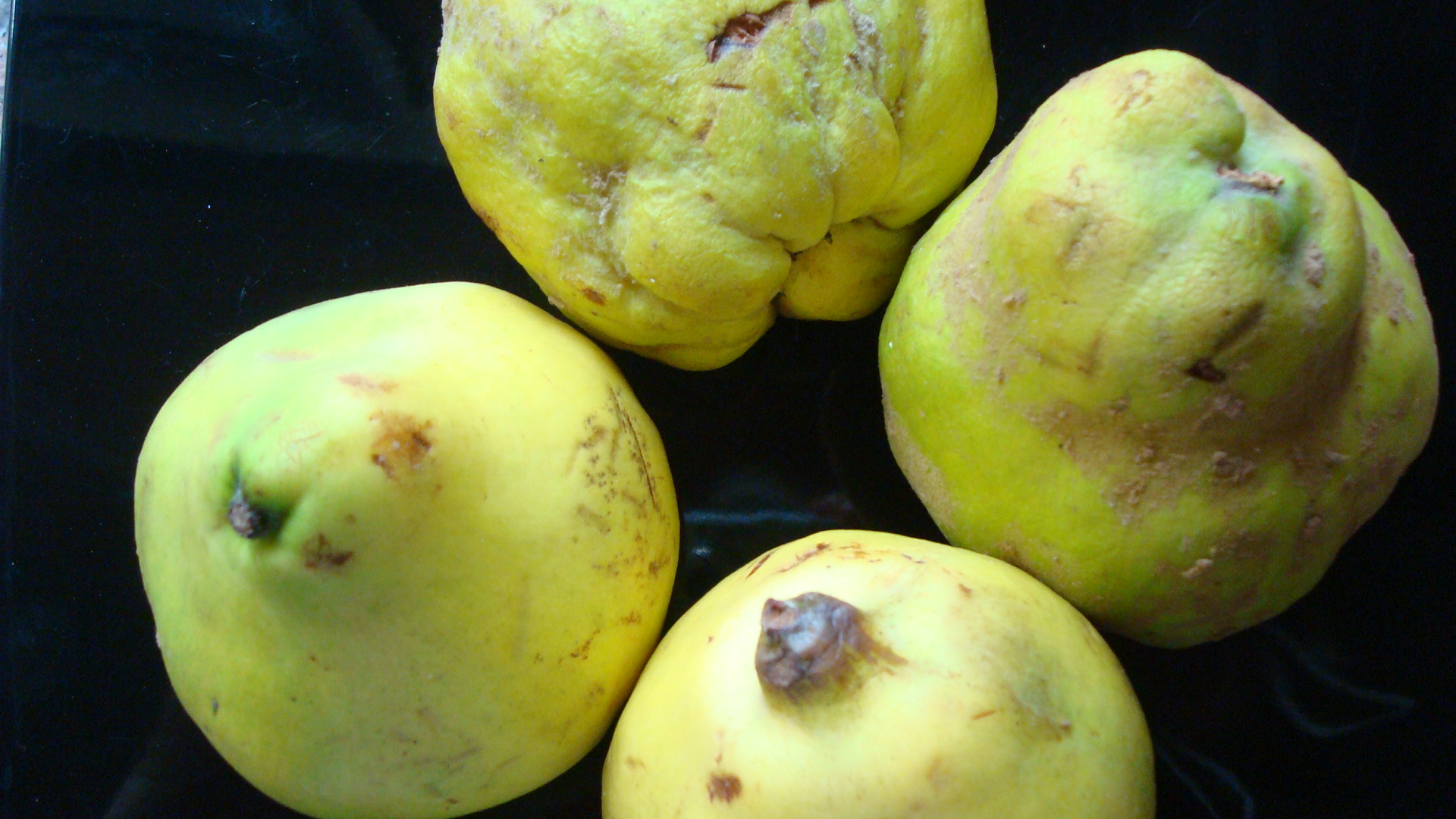
While scouring grocery stores last week in search of pumpkin puree and figs (to make jam, but I’m too late; they’re gone), I came across quinces. Had these quinces not been labeled, I would have walked right past them, as I’m oft to do with some of the other exotic and puzzling produce that I come across. My only familiarity to quince is from membrillo, or quince paste, which often accompanies cheese boards. I love membrillo and have bought it from gourmet grocery stores, but it’s extremely expensive for a small container. I had no idea how to make quince paste from these large, lumpy, and furry massive fruits, but figured I’d find a recipe online.
I bought four quinces, figuring that would be enough to make something and headed home to my computer. I found hundreds of recipes, all slightly different. Some called for peeling, then poaching the fruit, while others recommended roasting it. From what I read, the fruit is quite worthless unless you cook it first. I opted for the roasting method, hoping to avoid the peeling step, and modified a recipe from Gourmet (January, 1998).
My only alteration to the recipe below is that in step six, you wait until the liquid has turned a deep reddish hue. My quince paste is a little on the pinkish side as opposed to the deep, dark red that it should be. Regardless of the color, it tastes fantastic and was a hit at our Thanksgiving.
In addition to finding lots of recipes, I also found the history of quinces interesting. Here’s a snippet of quince trivia, which might come in hand if you’re ever playing the game Foodie Fight.
4 medium quinces (about 2 pounds total)
1/4 to 1/2 cup water
2 to 3 cups sugar
DIRECTIONS
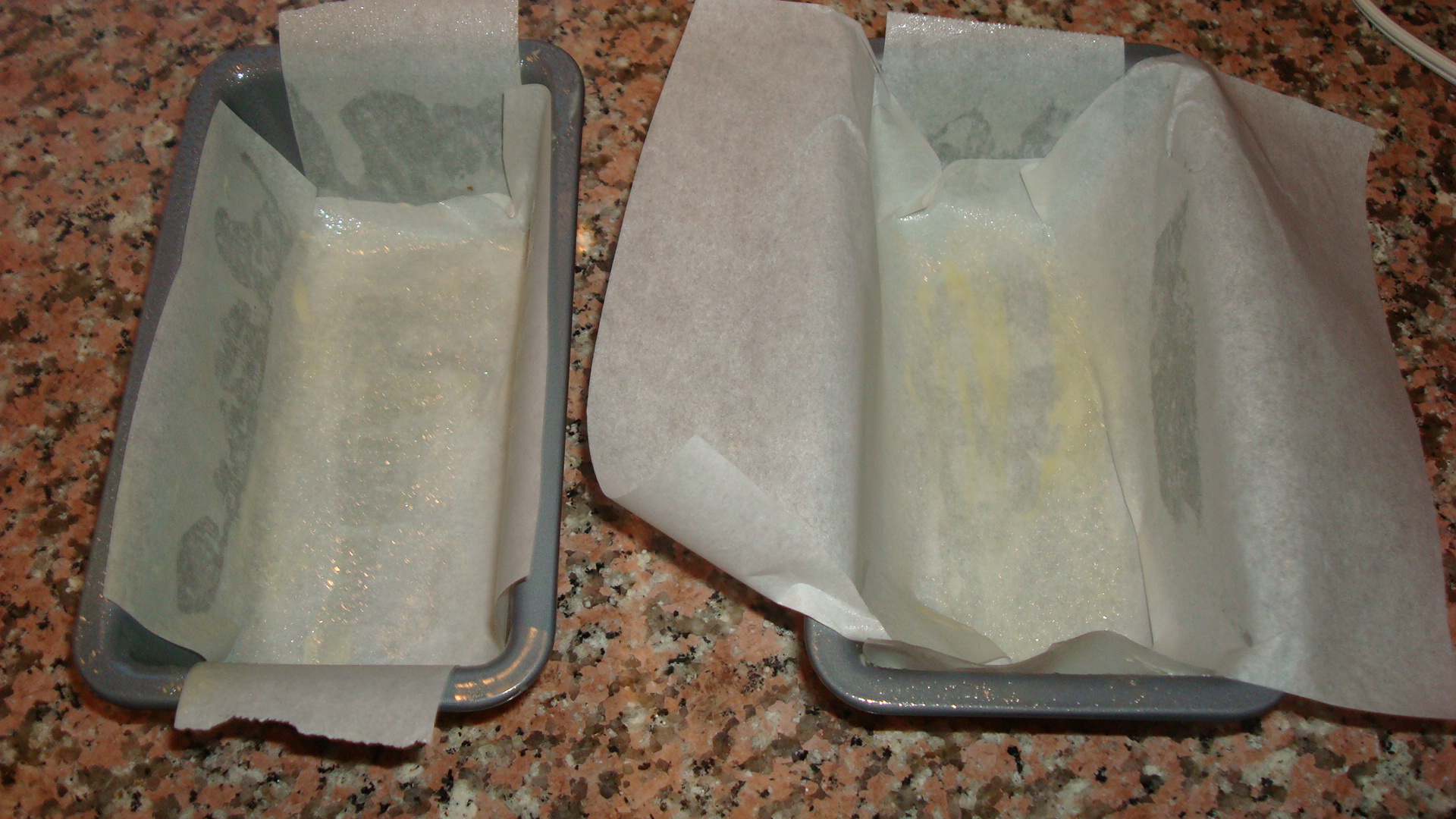
1. Preheat oven to 350°F and lightly oil a 1-quart terrine and line with buttered parchment. (I used a mini loaf pan instead.)
Mini loaf as a terrine (I only needed one)
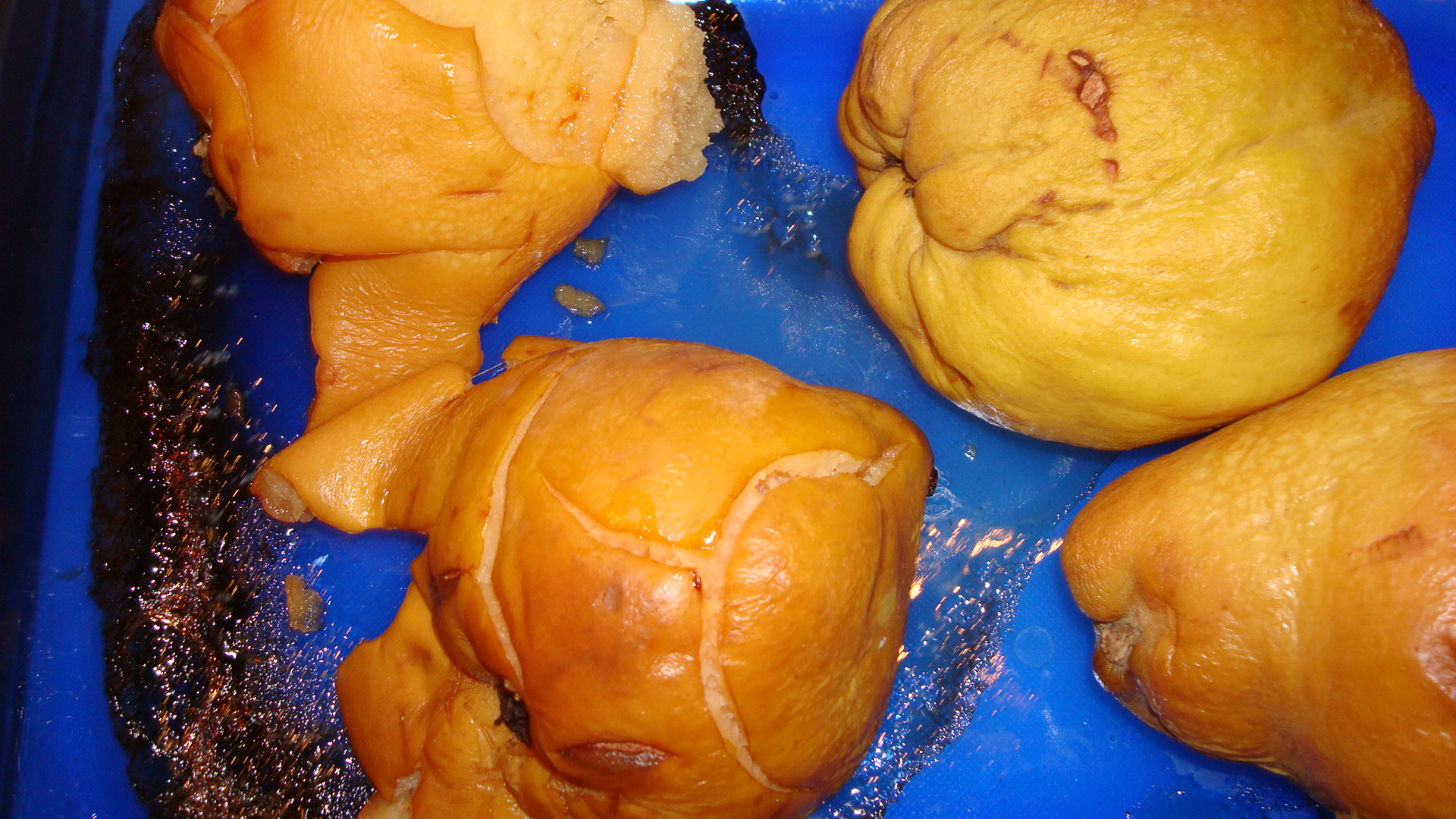
2. Scrub quinces and pat dry. (My quinces had a strange, furry coating that I rubbed off). In a small roasting pan bake quinces, covered with foil, in middle of oven until tender, about 2 hours, and transfer pan to a rack.
After quinces have roasted
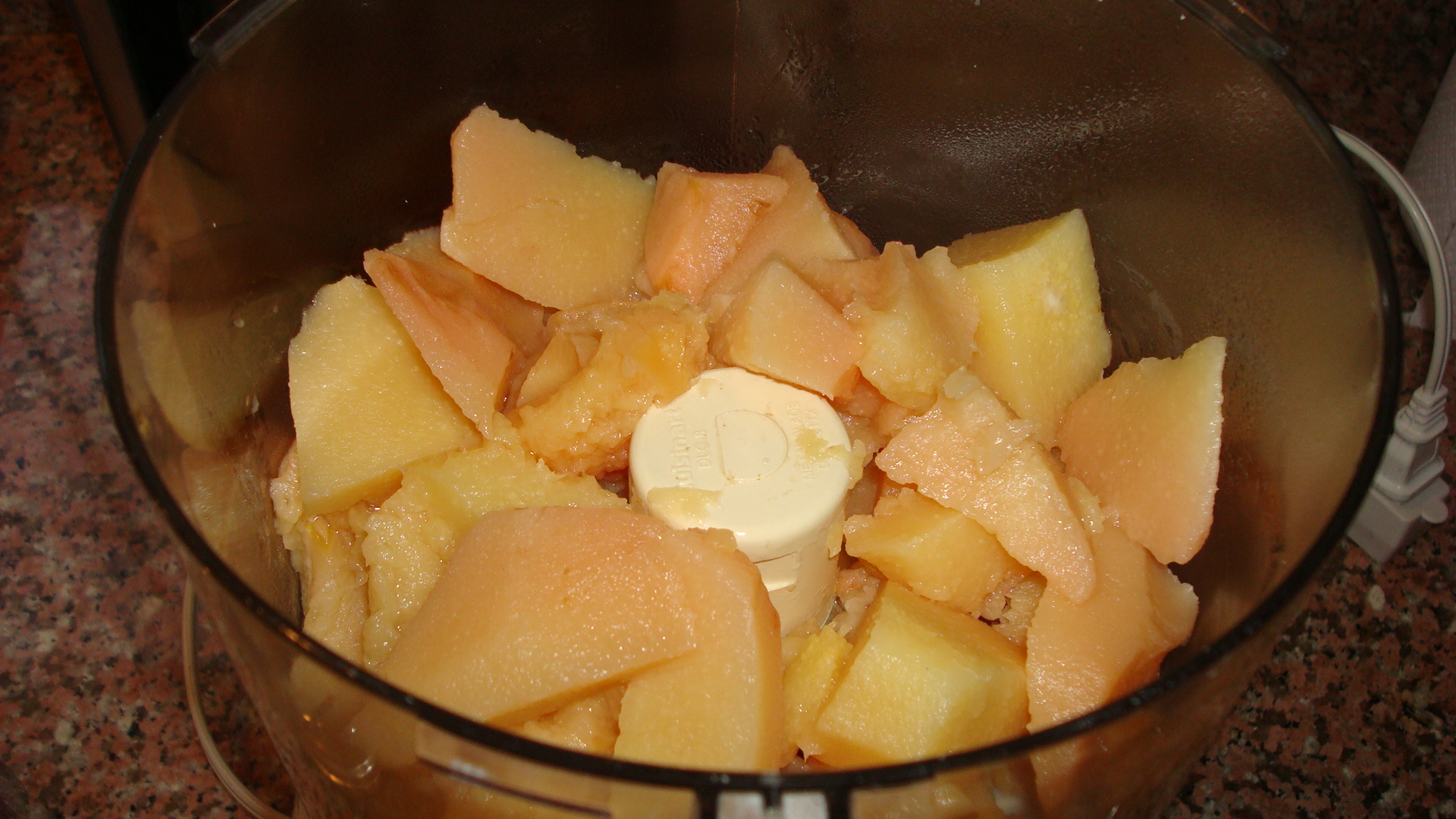
3. When quinces are cool enough to handle, with a sharp knife peel, quarter, and core them. 4. In a food processor puree pulp with 1/4 cup water until smooth (if mixture is too thick, add remaining 1/4 cup water a little at a time, as needed). Force puree through a large fine sieve or cheese cloth into a liquid cup measure and measure amount of puree.
Into the food processor
5. Transfer puree to a 3-quart heavy saucepan and add an equivalent amount of sugar.
I ended up adding 2 cups of sugar
6. Preheat the oven to 200 degrees. Cook quince puree over moderate heat, stirring constantly, until it is thickened and begins to pull away from side of pan, about 25 minutes. (Keep stirring until the liquid has turned a deep reddish color).
I should have waited until the color was a deeper reddish
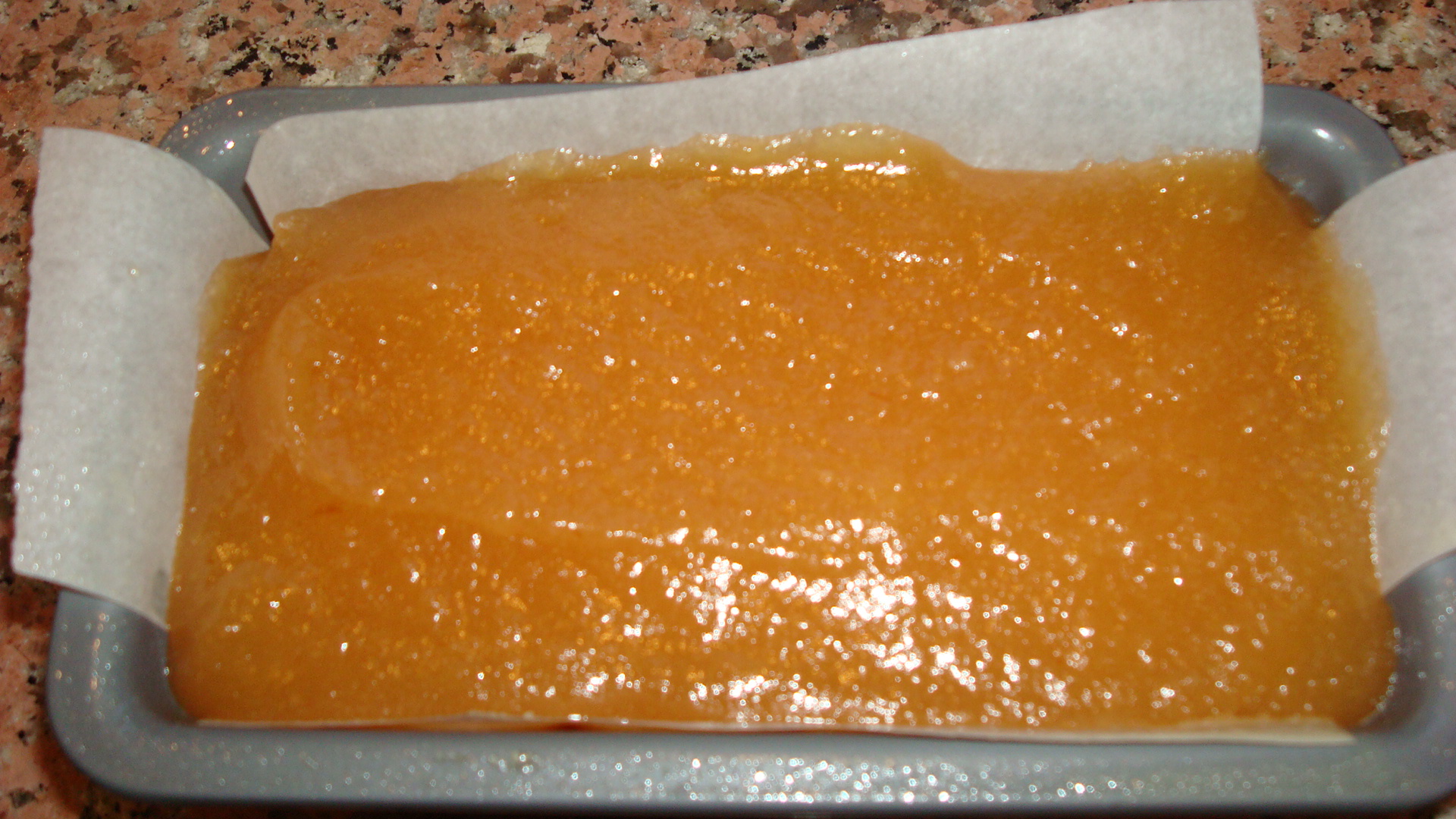
7. Pour puree into terrine, smoothing top with an offset spatula. Place in the oven for 1 hour and 30 minutes to further dry the quince paste. Cool and chill puree, loosely covered with plastic wrap, until set, about 4 hours.
Paste in the terrine
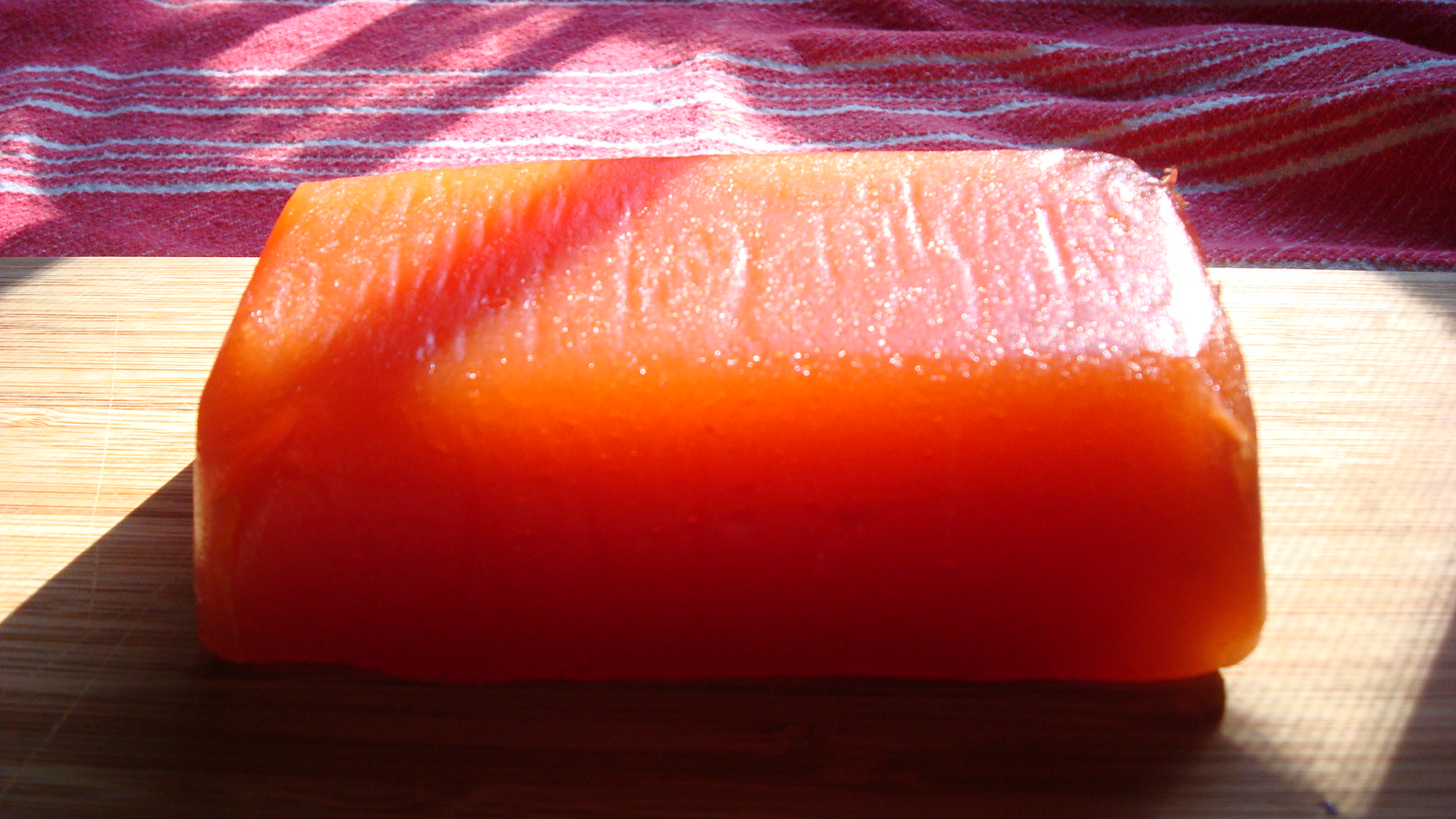
8. Run a thin knife around sides of terrine and invert quince paste onto a platter. (Quince paste keeps, wrapped well in wax paper and then plastic wrap and chilled, 3 months–I’ve also read that it keeps indefinitely. The sugar works as a preservative).
After 4 hours in the refrigeratorFinished product
9. Slice paste and serve with cheese and crackers.
Pumpkin bread, like banana bread, is one of the simplest and least fussy recipes I know. You basically ‘dump’ and mix all of the ingredients together in a bowl, place the loaf pan in the oven, and an hour or so later, you’re treated to a delicious smelling kitchen and a rich and spicy piece of heaven. However, when you’re in Jordan (and let’s not forget there’s always a snag or else this blog wouldn’t exist) finding canned pumpkin puree (even during the Thanksgiving season!) is near to impossible.
[Note: I’m sure some random person will comment that they’ve found it at such and such a place, but I’m telling you, I’ve now been to THREE large grocery stores in the area and cannot find it ANYWHERE!]
Lucky for me though (and Raj), I planned ahead in the event something like this were to occur–I packed (way back in April) one 28 ounce can of leftover pumpkin puree. Knowing now that I cannot find canned pumpkin anywhere else, pumpkin pie is off the Thanksgiving menu this year. I need to save the remaining leftover from the can for the next (and sadly) last pumpkin loaf we will eat this fall.
[This recipe is modified from The Art and Soul of Baking, by Cindy Mushet]
Makes 1 loaf
Ingredients:
2 cups unbleached all-purpose flour
3/4 tsp baking soda
1/2 teaspoon ground cinnamon
1/4 tsp. allspice
1/4 tsp. ground cloves
1/4 tsp. ground ginger
1/4 tsp. salt
2 large eggs at room temperature
1/3 cup water
1 1/2 cups sugar
1 cup canned pumpkin puree
1/2 cup canola oil
1 tsp. pure vanilla extract
1 cup chopped toasted walnuts
1/2 cup semi-sweet chocolate chips
Directions:
1. Preheat oven to 350 degrees and position rack in the center. Lightly coat a 9-by 5-inch loaf pan with Pam or other oil spray. In a large bowl, whisk together the flour, baking soda, cinnamon, allspice, cloves, ginger, and salt until thoroughly blended. In a medium bowl, whisk together the eggs and water. Add the sugar and blend well. Add the pumpkin puree, canola oil, and vanilla extract and blend well.
2. Add the pumpkin mixture to the dry ingredients and whisk until blended and smooth. Add the walnuts and chocolate chips until they are evenly distributed. Use a spatula to scrape the batter into the prepared loaf pan and level the top.
3. Bake for 55 to 65 minutes, until the bread is firm to the touch and a toothpick inserted into the center comes out clean. Transfer to a rack to cool completely.
Who knew that Jordan produced wine? Not me. What’s even more exciting is that this particular winery is completely organic (and certified organic)! No big deal for people who have access to Whole Foods, but for me here, this is huge!
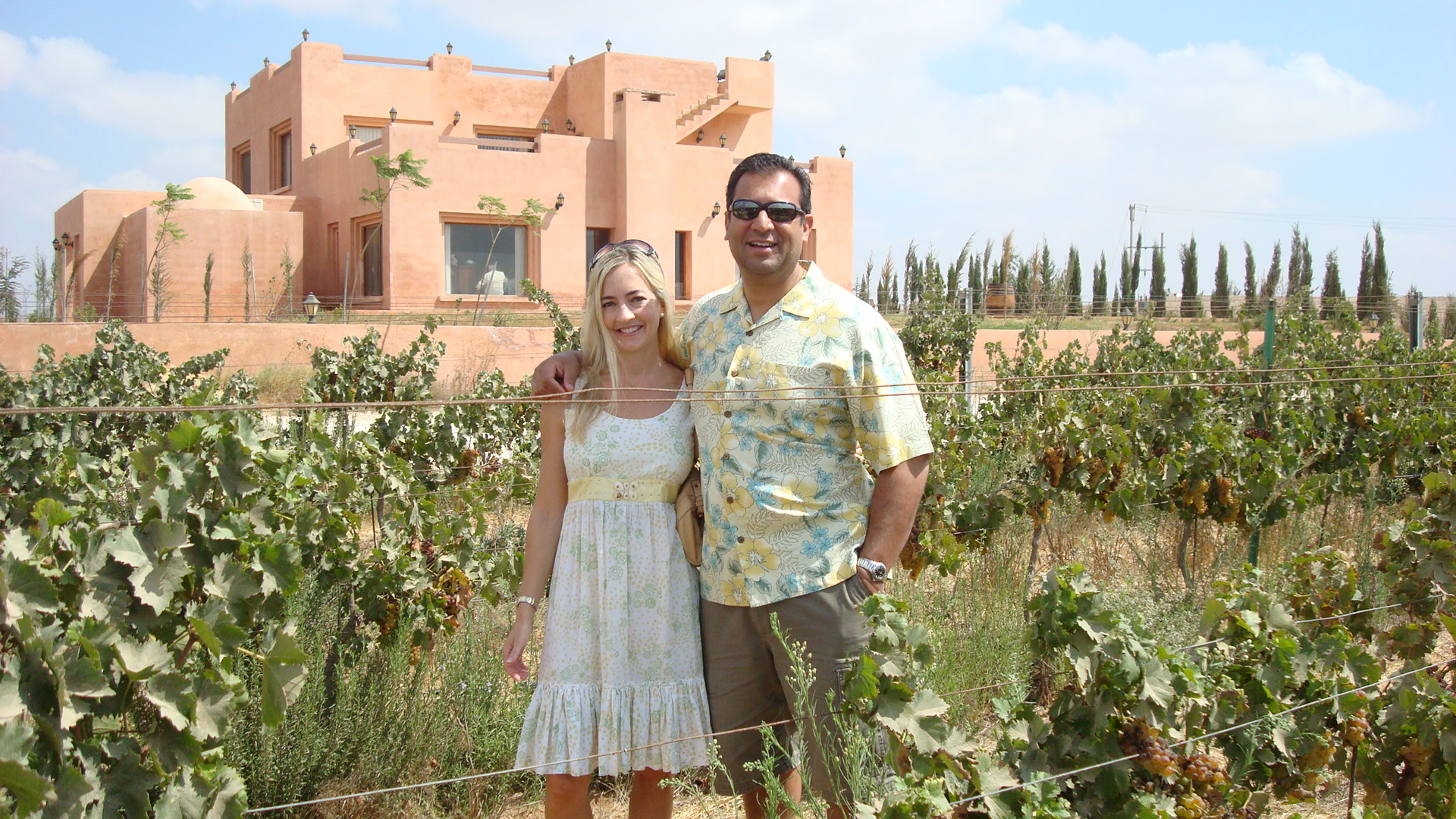
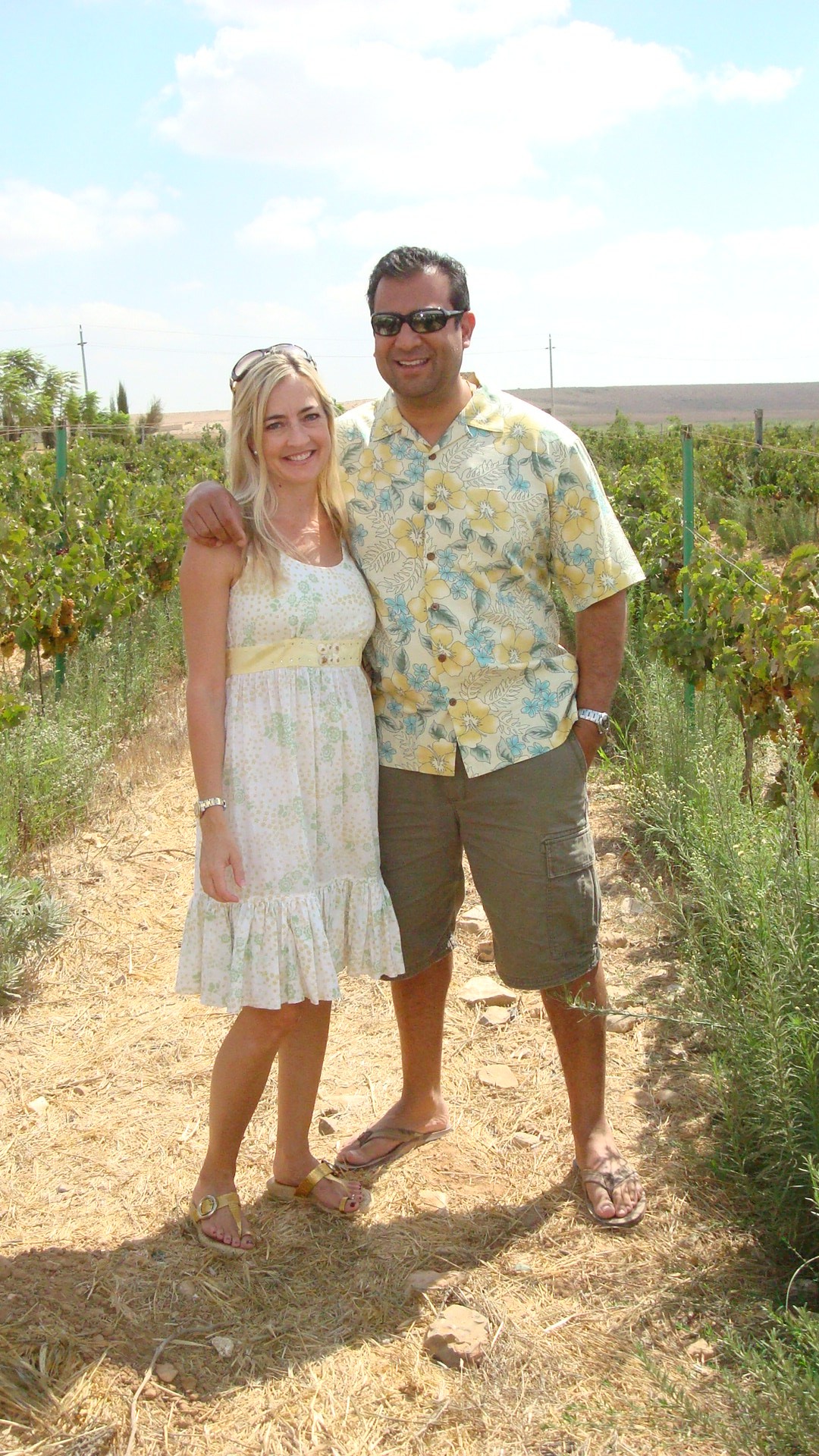
We went wine tasting today at St. George’s Winery, near the Syrian border (literally steps away), about an hour outside of Amman. I wasn’t sure what to expect but was surprised by a gem in the midst of nowhere.
Vineyards off in the distance
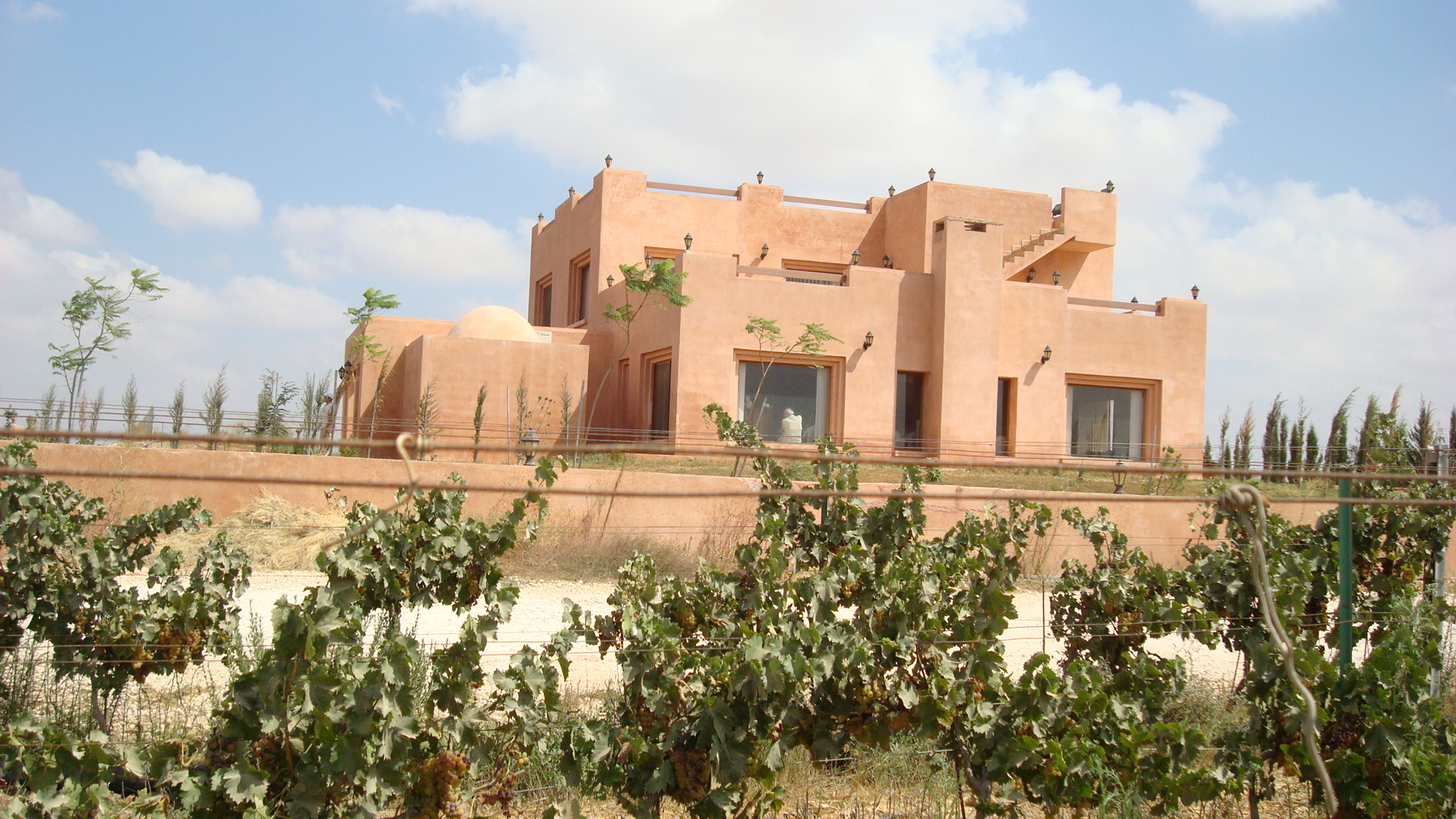
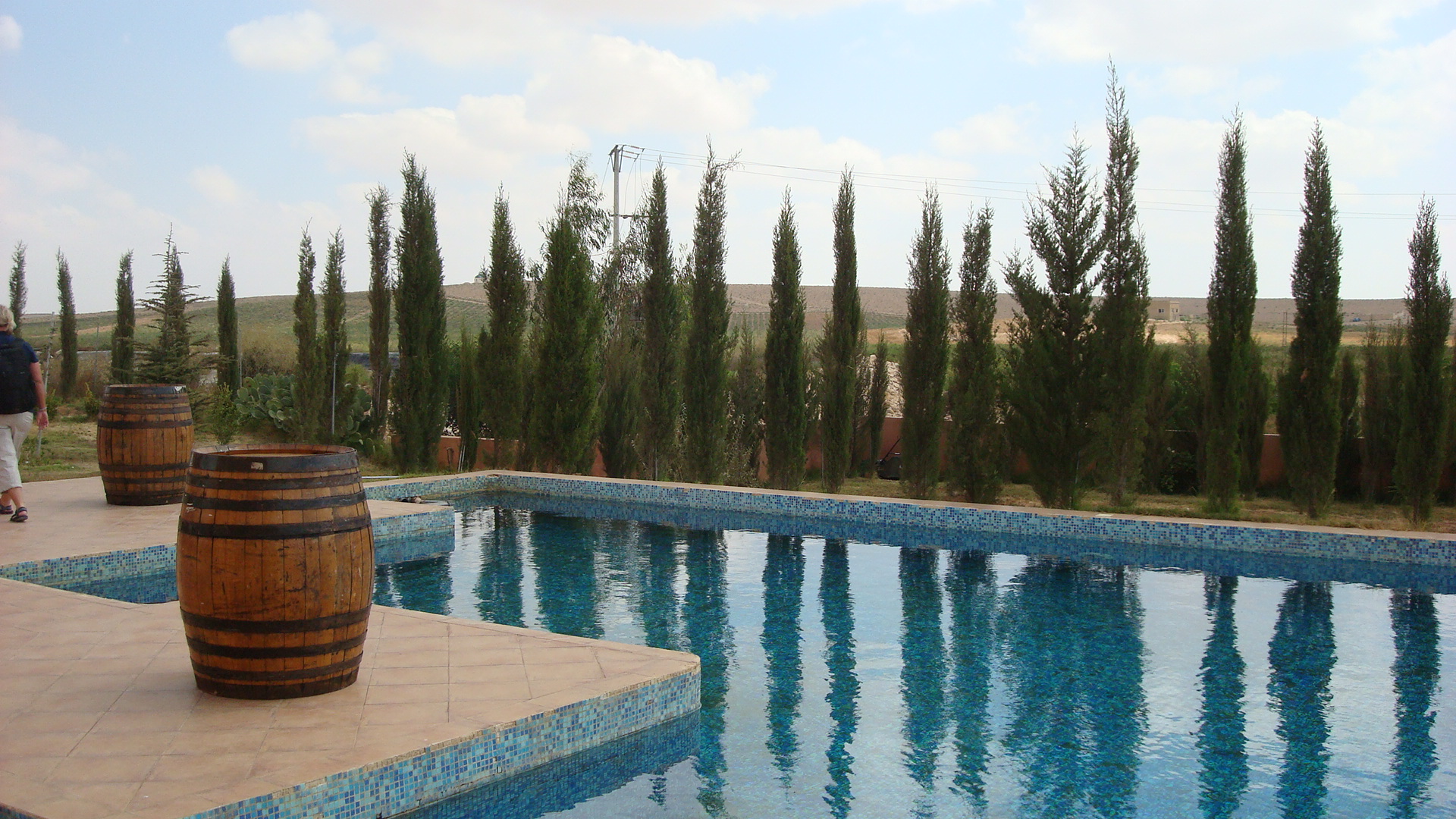
We pulled up in front of the estate on the property, a fairly large home (tasting room?) and were welcomed in by friendly staff. The interior of the home was set up for the wine tasting followed by lunch. In the backyard was a beautiful and inviting swimming pool, which we were invited to use after lunch.
The estate on the propertyThe swimming pool
The tour of the grounds began next to the pool in front of a large pond (or water containment area) used for irrigating the vines. The tour guide explained that the pond (fed from wells below ground) contains over 55,000 fish (some koi, some carp). The fish produce nitrate in the water, which they use to irrigate the fields. The fish, along with many other biodiversity techniques are used throughout the operation: to keep the birds out of the grapes, they brought in falcons and owls; chickens are used to aerate the ground and to dig up worms; doves are also used to eat worms that attack the grapes; (they brought something else in to keep the foxes from eating the chickens, but I can’t remember what he said).
Fish in the pond producing nitrate for irrigating the fieldsA feeding frenzy
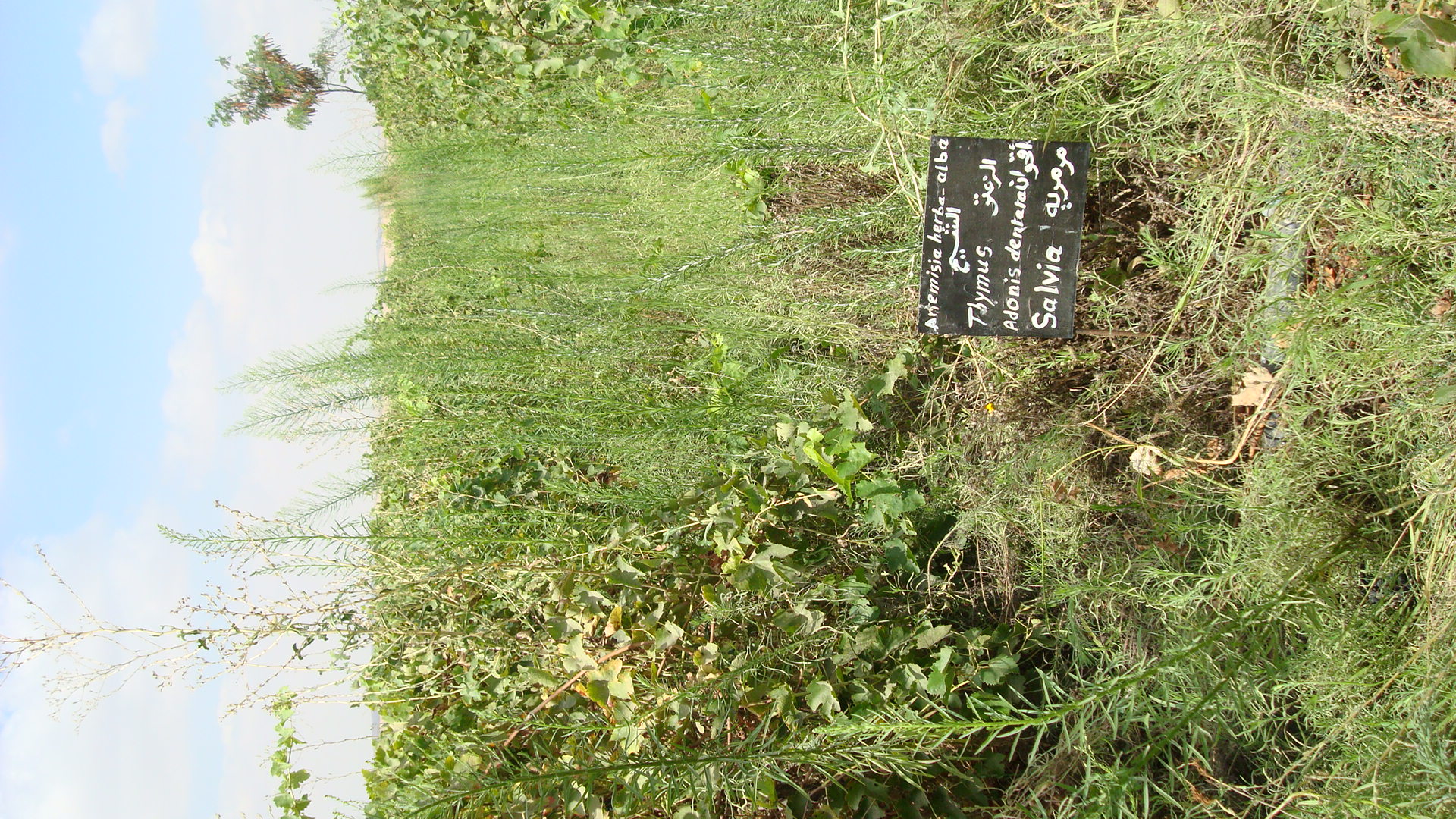
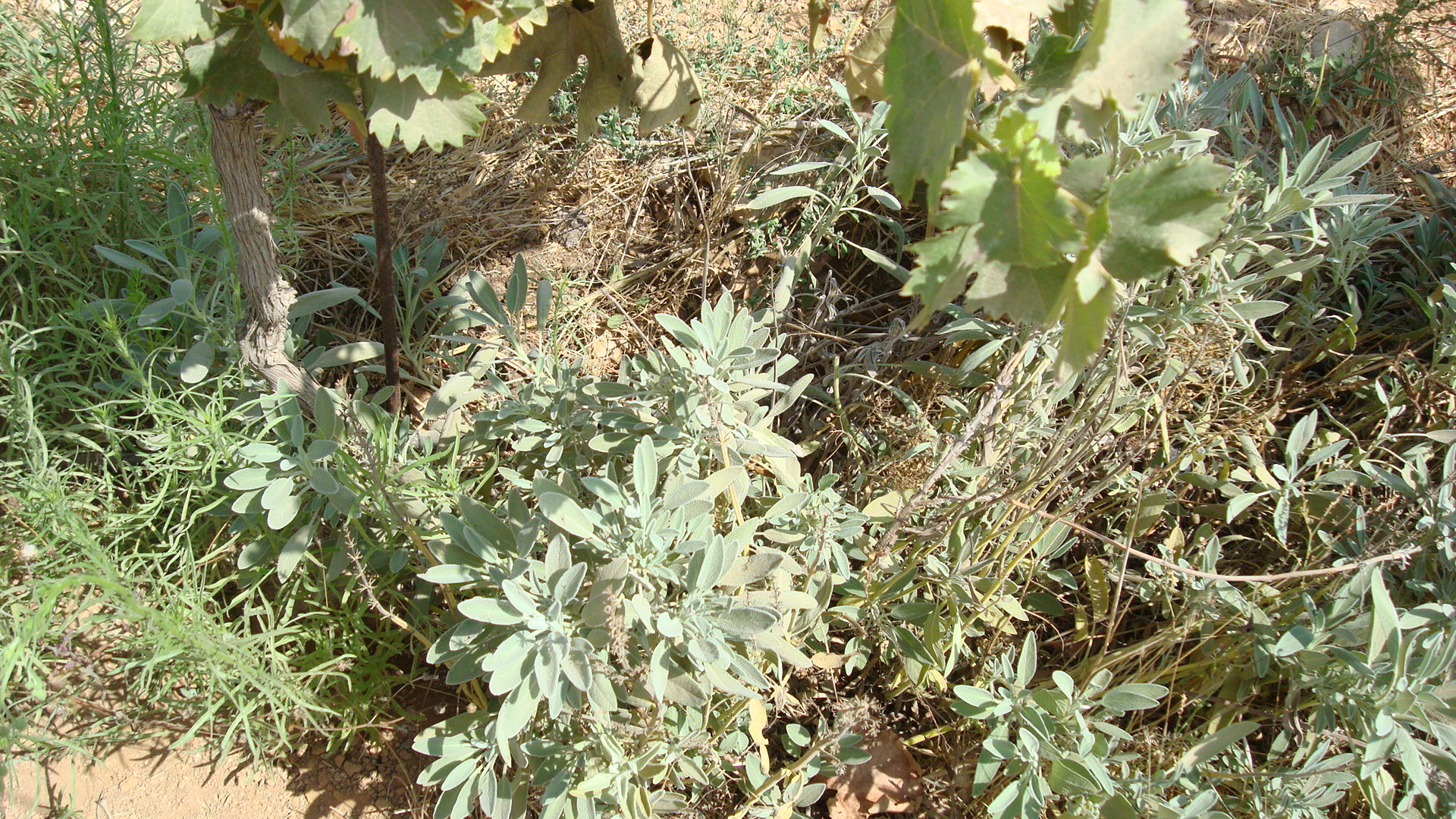
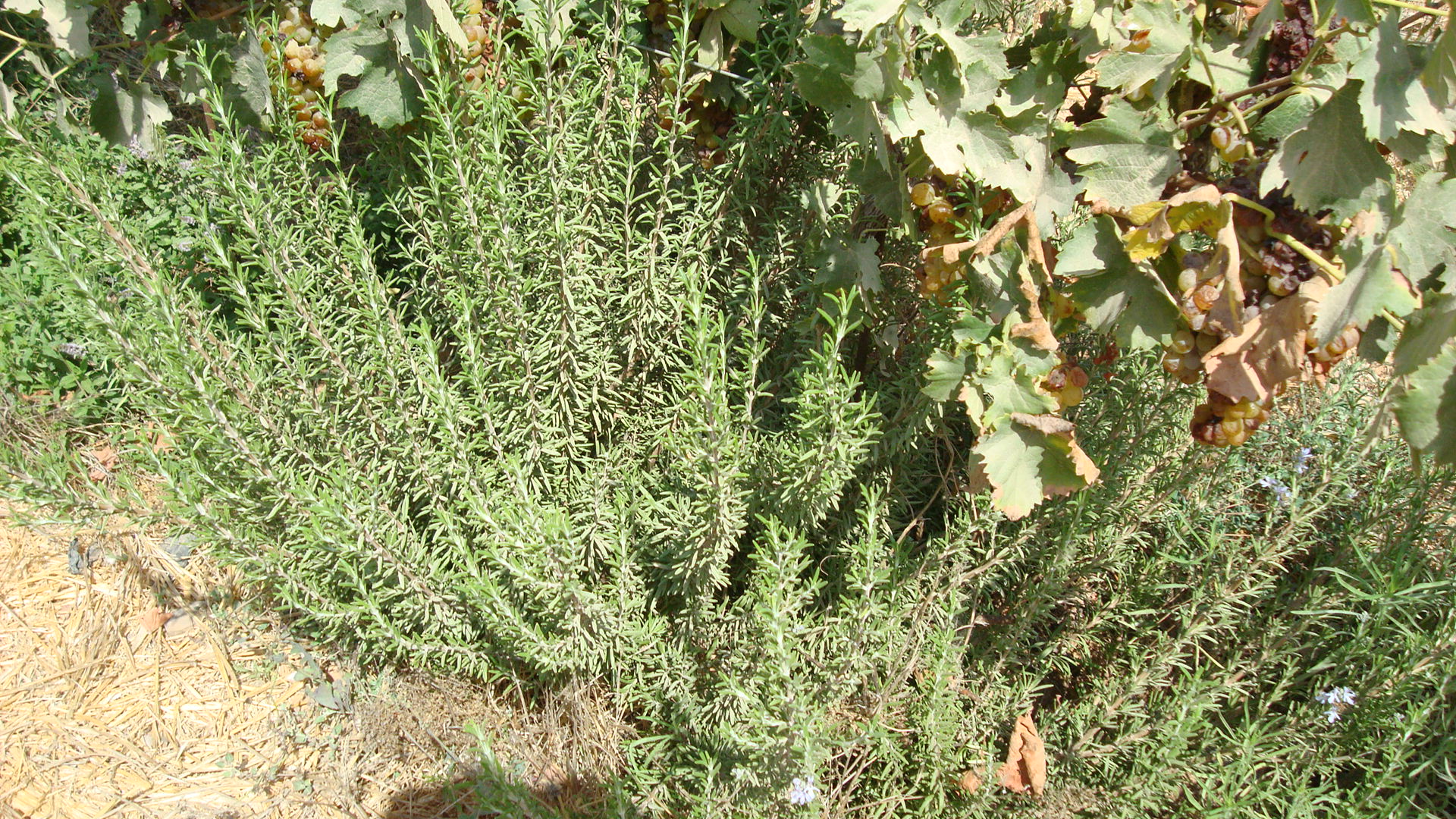
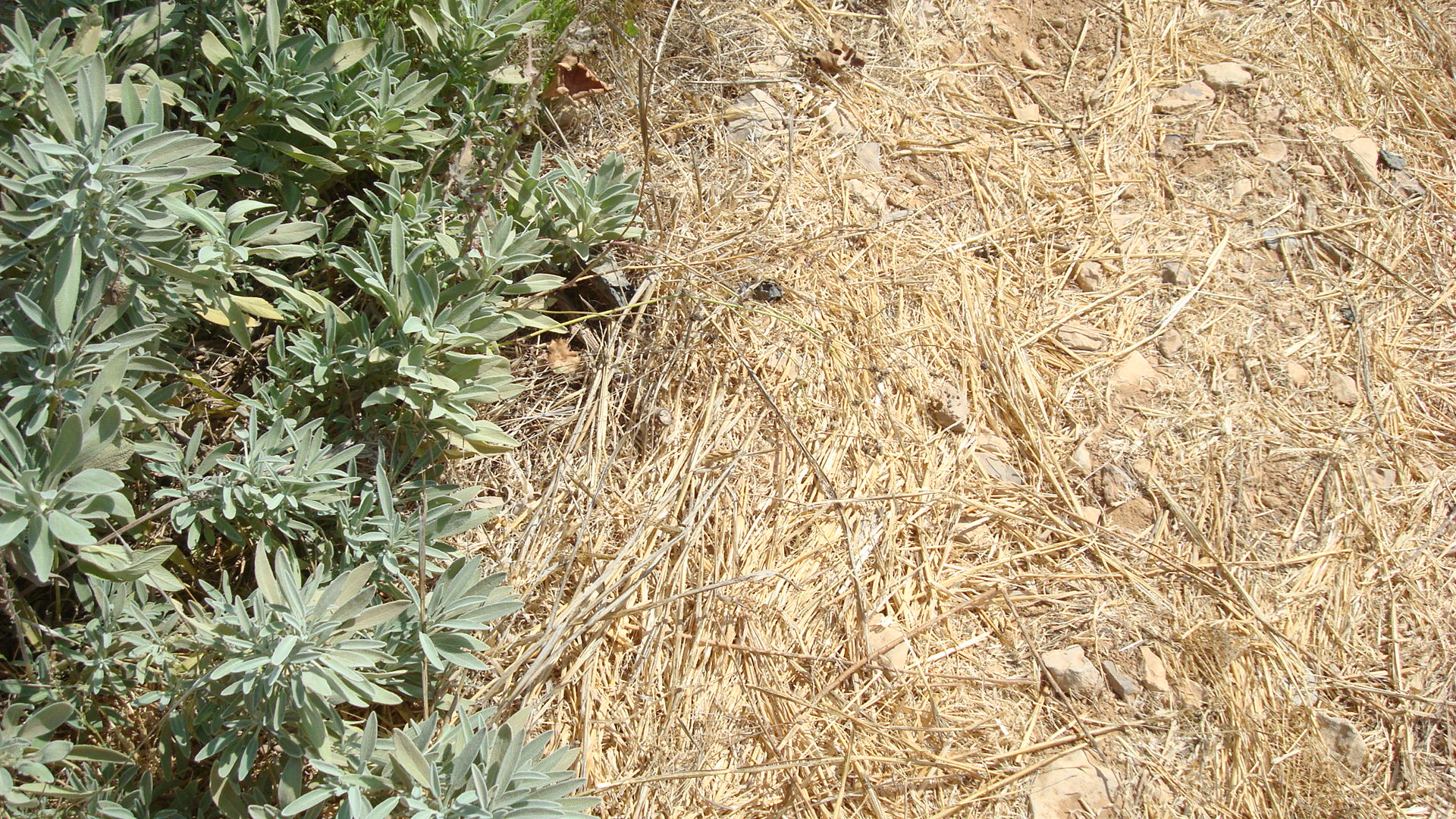
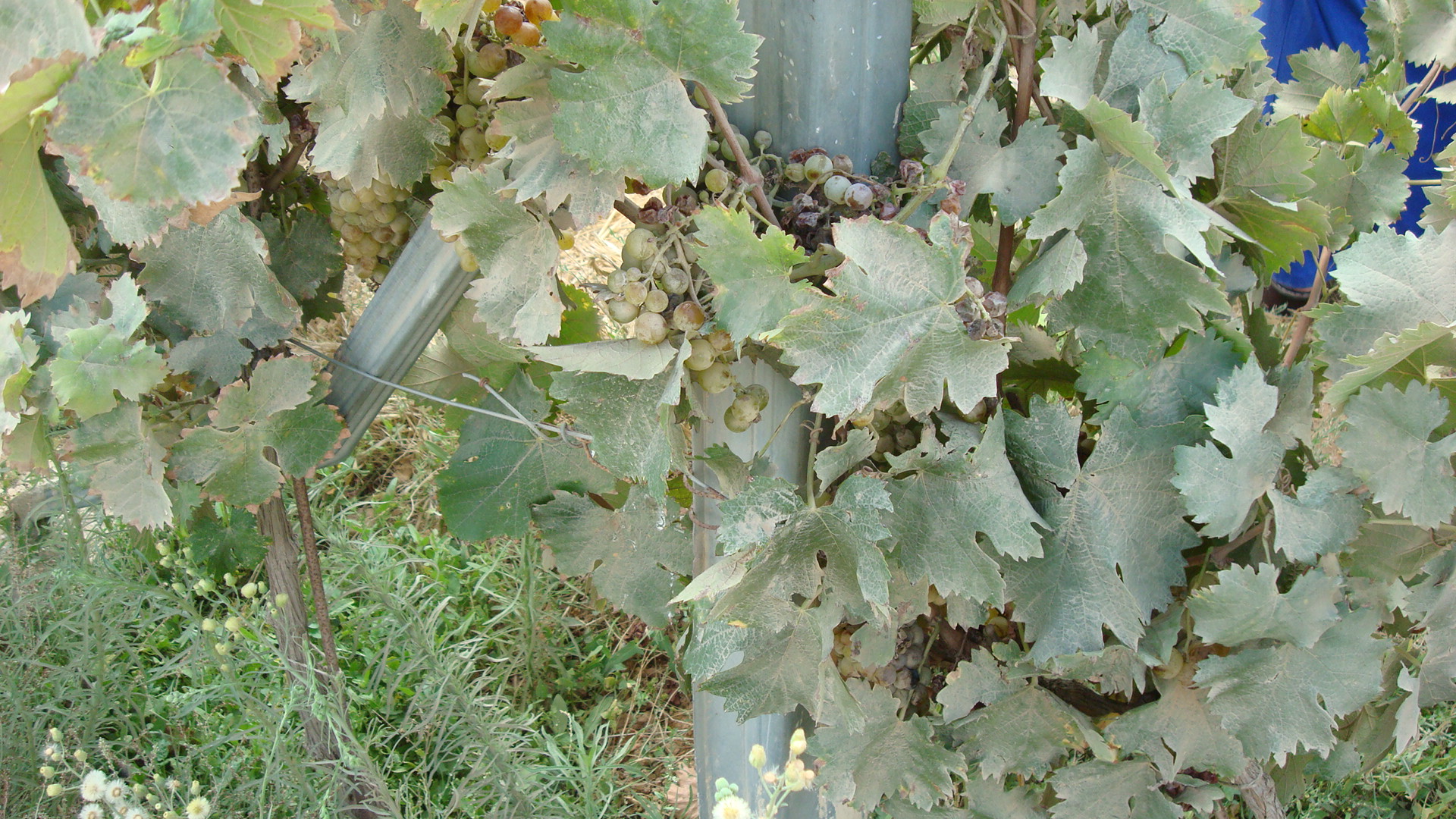
After our brief introduction to the winery, we walked us through rows and rows of vines, sampling Muscat, Pinot noir, Shiraz, Chardonnay, and lots of other grapes right off the vine. Planted alongside the vines are rosemary, sage, and mint– all natural insect repellents and on the ground of each row is barley to extract salt from the soil.
Sage
Barley
After the tour, we returned back to the main house and were treated to nine wines: 4 whites, one rose, and 4 reds and a fantastic lunch (As a side note, I was shocked to see the rose had 16% alcohol! ) Unfortunately, there was no gift shop–something they need to get working on.
Here’s a link to a CNN piece on St. George’s Winery.
It’s been awhile, I know. I’ve missed blogging and feel as though I’m just coming up for air after a long stretch of weekend teaching (just the last two weekends). As a result of ‘working,’ something that I haven’t done for a while, I’ve been neglecting my domestic duties (as Raj points out every time he opens the refrigerator door). What better way to jump back into the swing of things than with home-made bread. Want to be a hero or a goddess in your home? Bake this bread NOW. There’s nothing quite like the smell of freshly baked bread wafting through out of kitchen and into the rest of the house (apartment in our case).
Now you may be thinking that bread is for bakers (which I aspire to be) and a baker you are not? Never fear! This fabulous book that I’ve just recently cracked open (one of the few to travel with me) makes baking fuss-free and requires no-kneading. Is that even possible? Yes. The secret to this book is through letting the dough slow rise, which allows it to knead itself (it’s magic!). Additionally, most of the recipes are made in one bowl with one spoon–a dream come true for those unfortunate few like myself who lack domestic help (alright, I do have help, but only one day a week) or a dishwasher (I’m still dealing with this one).
For this particular loaf, I used a large Le Creuset pot. I was worried about placing the lid in the over (it has a plastic knob) because the manufacturer claims it can only be heated to 350 degrees and this recipe requires 400 degrees. I’m happy to report that the knob was fine, so you needn’t worry about ruining your $250 pot.
French Walnut Bread from Nancy Baggett’s, Kneadlessly Simple:
2 cups whole wheat flour, plus extra if desired
2 cups unbleached all-purpose white flour
1 tsp. granulated sugar
2 tsp. table salt
3/4 tsp. instant, fast-rising, or bread machine yeast
2 cups ice water, plus more if needed
Walnut oil or flavorless vegetable oil for coating dough top and baking pot
1 1/2 cups fresh, fine-quality walnut halves
First Rise: In a large bowl, thoroughly stir together the whole wheat and white flour, sugar, salt, and yeast. Vigorously stir in the water, scraping down the bowl and mixing until the dough is well blended and smooth. If the mixture is too dry to incorporate all the flour, a bit at a time, stir in just enough more water to blend the ingredients; don’t over-moisten, as the dough should be very stiff. Brush or spray the top with oil. Tightly cover the bowl with plastic wrap. If desired, for best flavor or for convenience, you can refrigerate the dough for 3 to 10 hours. Then let rise at cool room temperature for 12 to 18 hours.
Meanwhile, reserve 4 perfect walnut halves for garnish. Spread the remainder on a baking sheet and lightly toast, stirring several times, in a pre-heated 325 degree oven for 10 to 15 minutes, or until fragrant and just lightly browned. Let cool. Chop finely (in a food processor, if desired).
Second Rise: Vigorously stir the cooled walnuts into the dough. If it is not stiff, stir in enough more whole wheat flour to make it hard to stir. Using an oiled rubber spatula, lift and fold the dough in towards the center, working all the way around the bowl. Invert it into a well-oiled, then flour-dusted, 3-quart (or larger) heavy metal pot (or use a flat-bottomed round casserole with a lid). Brush or spray the top with oil, then smooth out the surface with an oiled rubber spatula or fingertips. Cut 1/2-inch deep slashes to form an X in the center top; well-oiled kitchen sheers work best. Put the 4 untoasted walnut halves in the angles of the X for garnish; press down very firmly to embed them. Cover the pot with its lid.
Let Rise Using Any of These Methods: For a 1 1/2 – to 2 1/2-hour regular rise, let stand at warm room temperature; for a 1 – to 2-hour accelerated rise, let stand in a turned-off microwave along with 1 cup of boiling-hot water; or for an extended rise, refrigerate for 4 to 24 hours, then set out at room temperature. Continue until the dough doubles from its deflated size.
Baking Preliminaries: 15 minutes before baking time, place a rack in the lower third of the oven; preheat to 400 degrees. Lightly dust the dough top with whole wheat flour.
Baking: Bake on the lower rack, covered, for 45 minutes. Remove the lid and continue baking for 20 to 30 minutes, or until the top is well browned and a skewer inserted in the thickest part comes out with just a few particles clinging to the bottom (or until the center registers 207 to 210 degrees F on an instant-read thermometer). Then bake for 5 minutes more to ensure the center is done. Cool in the pan on a wire rack for 10 minutes. Remove the loaf to the rack, running a knife around the edges to loosen it, if necessary.
Serving and Storing: The loaf tastes and slices best at room temperature. Cool completely before storing airtight in plastic or foil. The bread will keep at room temperature for up to 3 days, and may be frozen, airtight, for up to 2 months.
We finally made it to Citadel Hill! This was our second attempt (after getting horribly lost the last time) in one month. It was no easy feat either; we had to go through City Center, the flea market area, which was more happening than normal. I saw fake Louis Vuitton’s on the street too, if anyone’s interested.
Citadel Hill, or Jebel al-Qal’a has been a happening place since the Paleolithic Age (that’s 18,000 years in case you don’t know your ages–I had to look it up). When the Romans moved in, they cleared away previous civilizations by chucking stuff over the hills, leaving heaps of archaeological booty. The two main features of the Citadel include the Temple of Hercules and the Umayyad Palace.
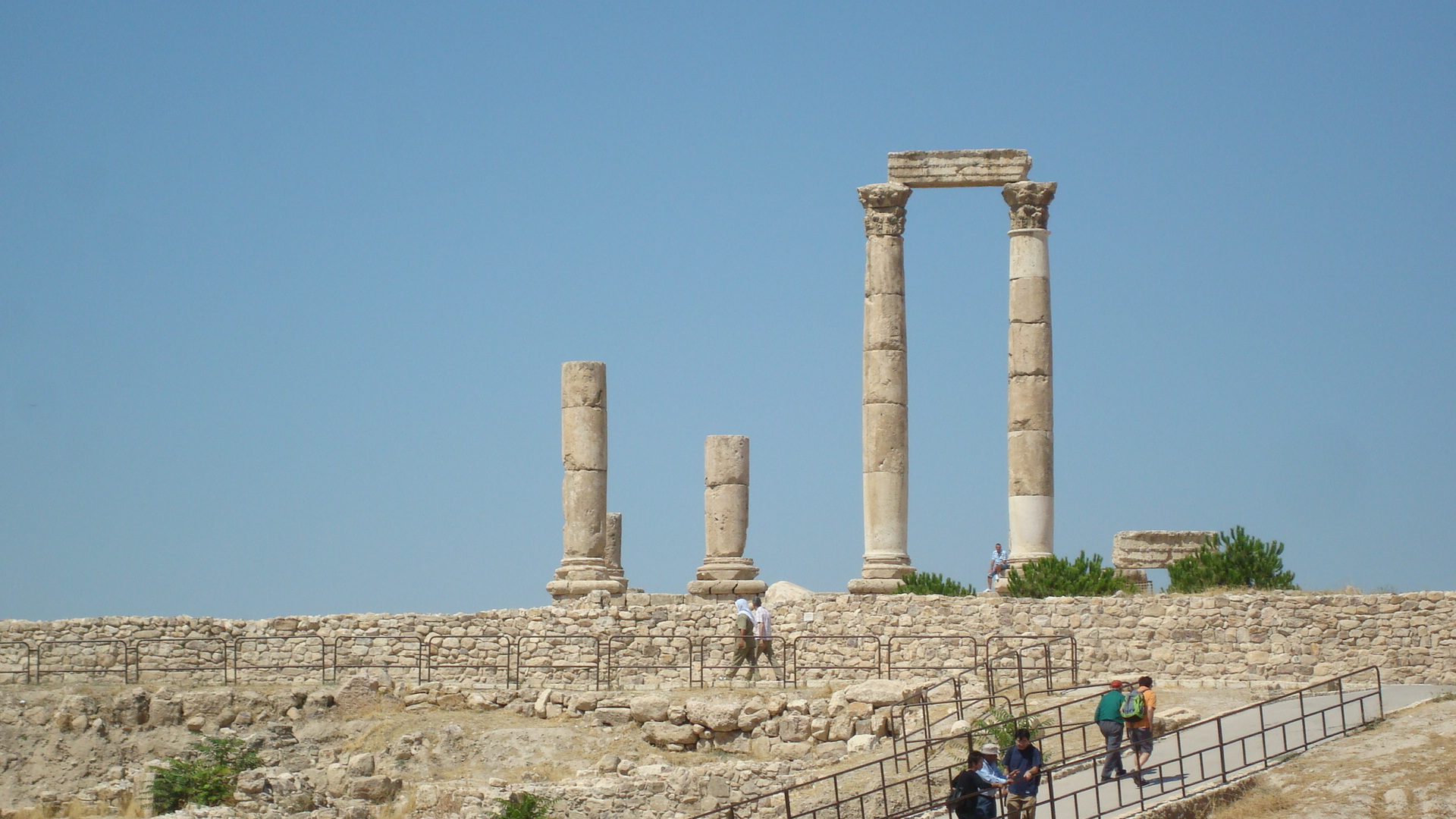
Temple of Hercules
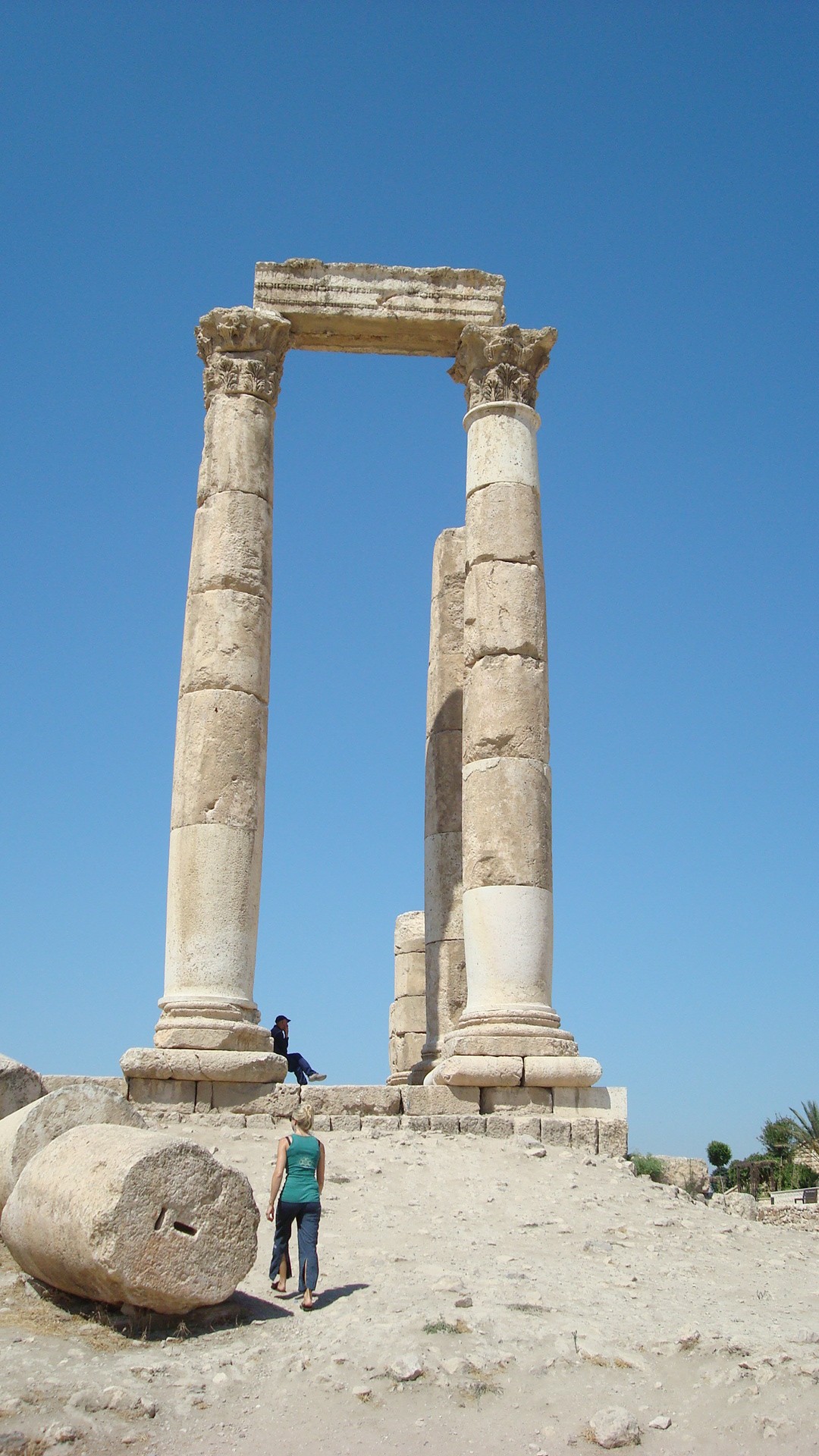
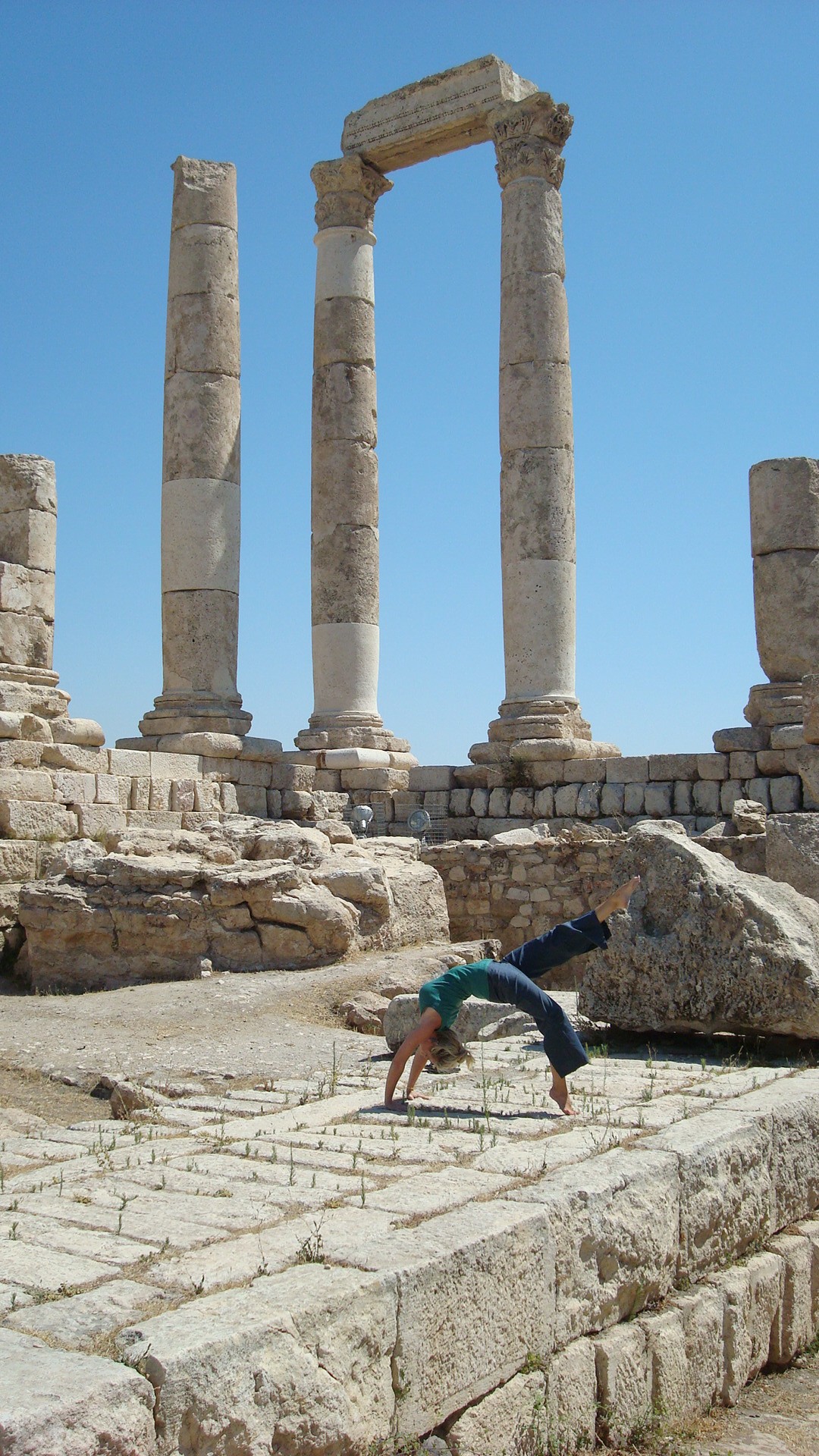
The Temple of Hercules was built around the same time as the Roman Theater (across the hill). Remember when that was? Didn’t you read my post? [It was built between 169 and 177 AD]. The columns were re-erected in 1993 and lead to the inner sanctum (a.k.a. the cella). Within the inner sanctum, there’s a patch of bare, exposed rock believed to be ‘sacred rock’ that formed the centerpiece of the 9th century BC Ammonite Temple of Milcom. The dedication to Hercules isn’t really known, but due to the large amount of coins with images of Hercules, they believe it’s all in his honor.
Temple of HerculesRoman Theater across the wayYou can see how massive the columns are in relation to me.
Yoga Graffiti!
No trip to ruins would be complete without a few yoga graffiti poses to which I have to thank Raj, the photographer. Don’t think I’m the only obnoxious yogi who does this either! As it turns out, there was a guy traveling alone who asked us if we could take a few pictures of him meditating, which we gladly did. He’s a yoga instructor from Mexico.
Scorpion on the "sacred rock" of the Ammonite Temple
The Umayyad Palace
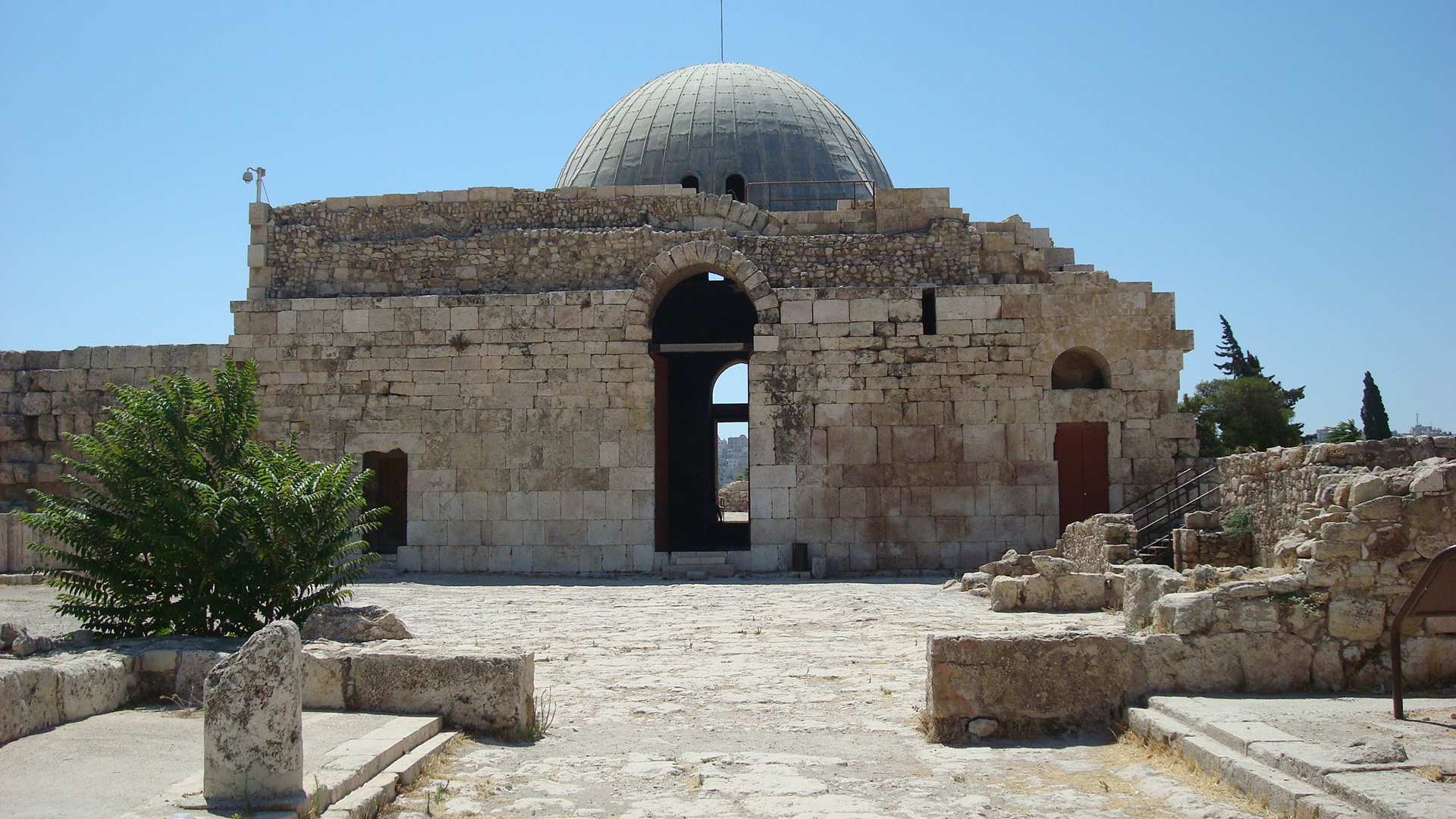
Beyond the Temple of Hercules are the ruins of a small Byzantine church, in front of which stands the Umayyad Palace. The palace was built over the remains of a pre-existing Byzantine building, which is why it’s in the shape of a cross. There’s a dome on top of the palace, which is rife with controversy as to whether or not it’s historically accurate or if there ever was a dome on top. The interior of the palace is massive, much more so than you would expect from the exterior. As you exit the palace on the other side, opposite the entrance, you walk through a colonnaded street that leads to what are believed to have been administrative offices.
Small ruins of Byzantine churchThe Umayyad PalaceInterior of Umayyad PalaceOpposite entrance of Umayyad Palace
There’s a museum up here as well that houses a collection of interesting artifacts found on the the site of Citadel Hill. I found these ‘pod’ shaped coffins to be the highlight of the collection. I’ve never seen anything like them. They’re constructed of pottery and remind me of the pods from the movie Cocoon. Remember that movie? It was horrible, but I think they stole the idea from these pods.
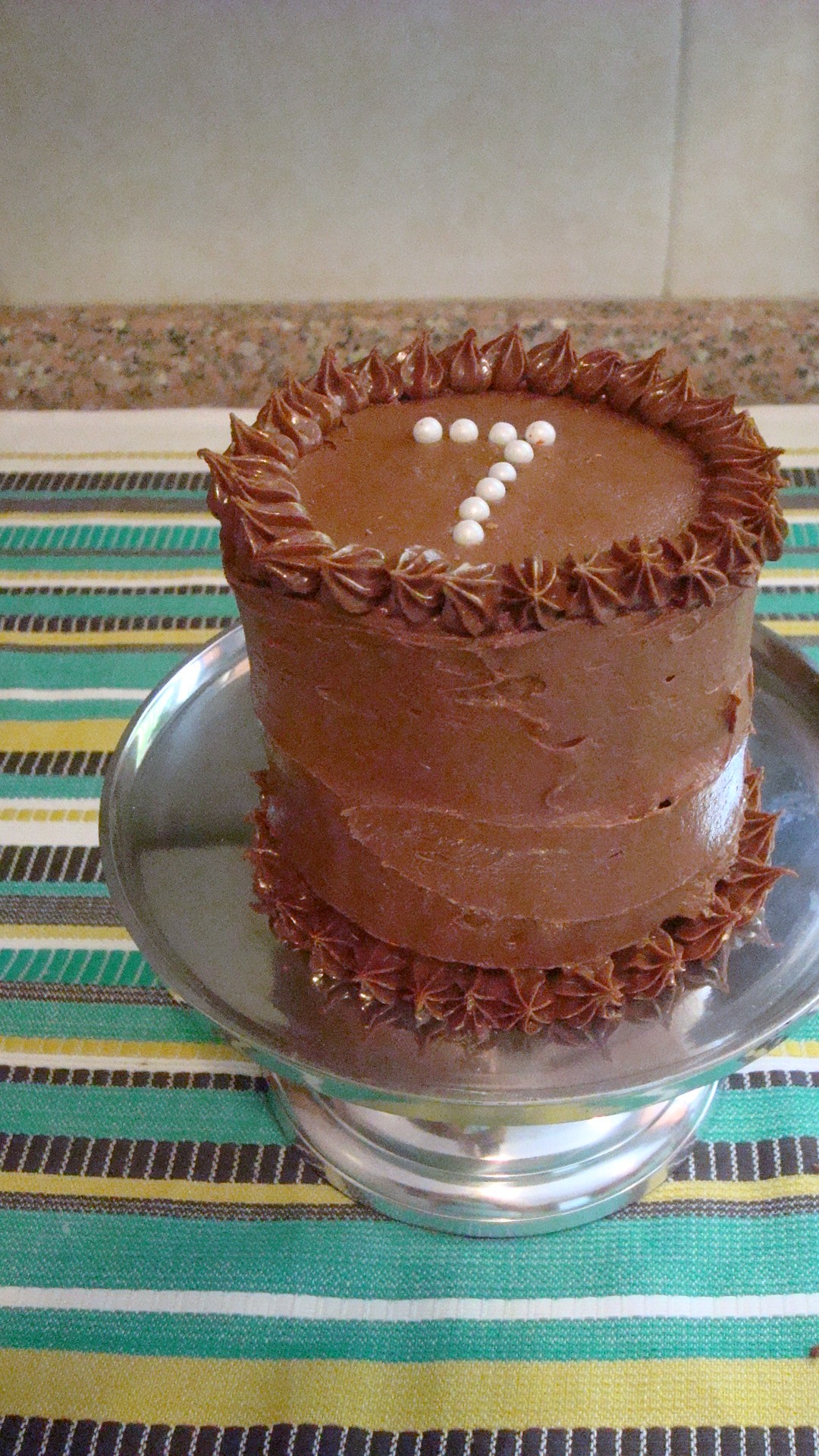
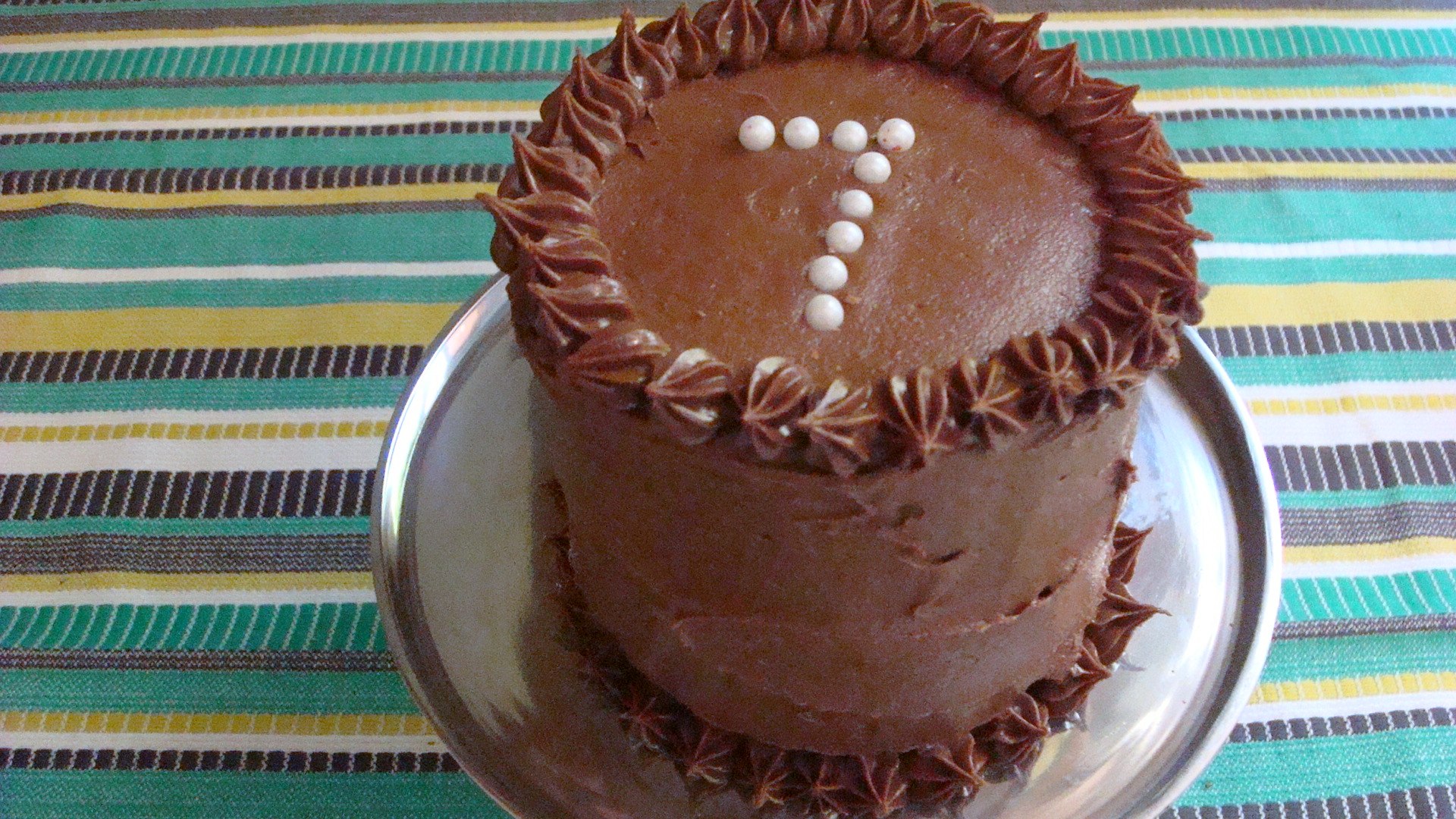
Today is our seventh wedding anniversary. Normally, we’d go out, exchange gifts, cards, go away for the weekend…but not this year. Dinner out during Ramadan means buffets for iftar, and I DO NOT DO buffets, especially on special occasions. So, to avoid the buffet bar, I’m cooking our meal tonight, which isn’t a problem, except for the ingredient thing that keeps getting in the way of good food. I searched through my paltry shelves of cookbooks last week, which prompted my previous post, and found a few things to make tonight that I’d normally not consider special:
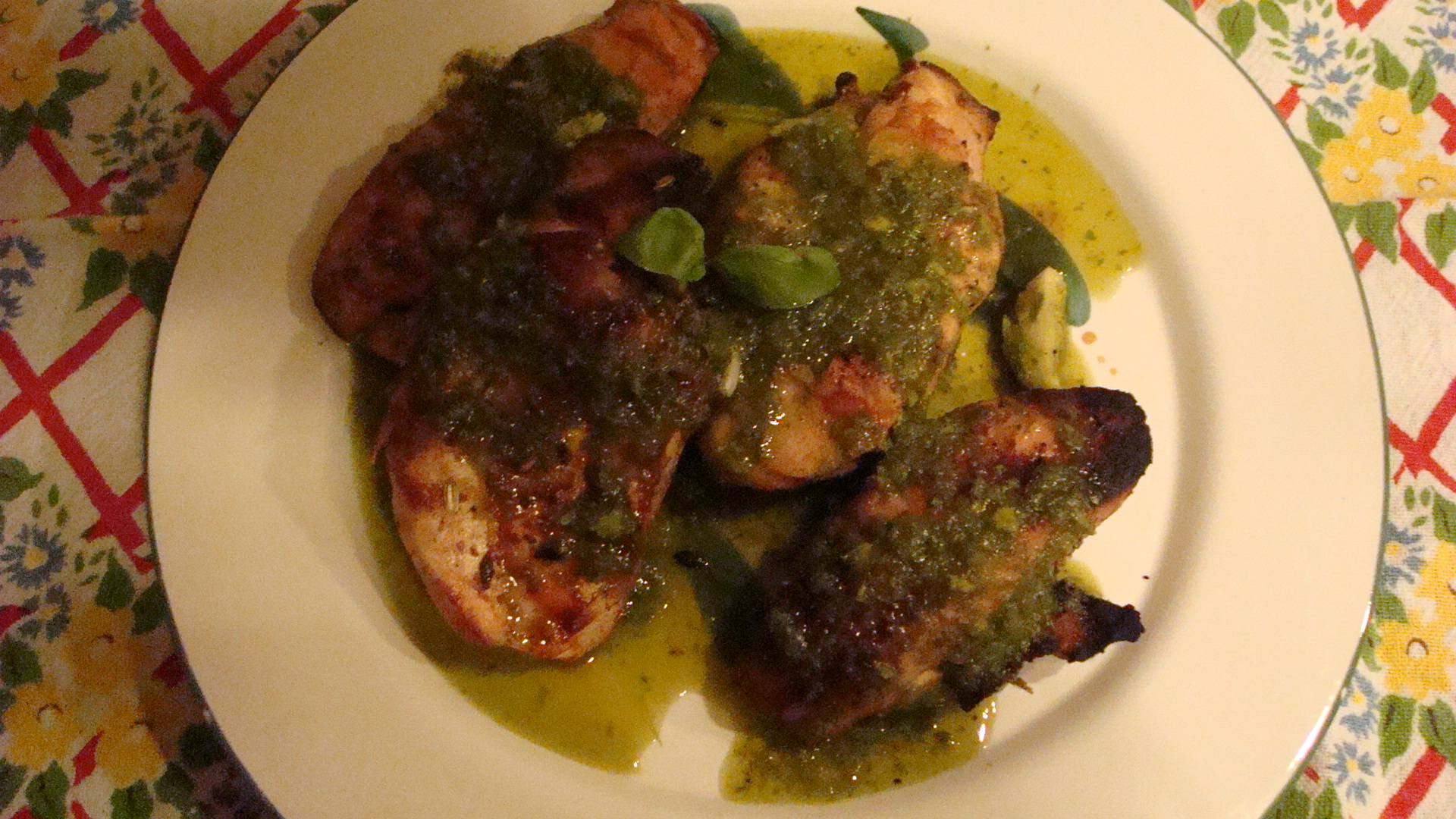
Grilled Chicken with Basil Dressing
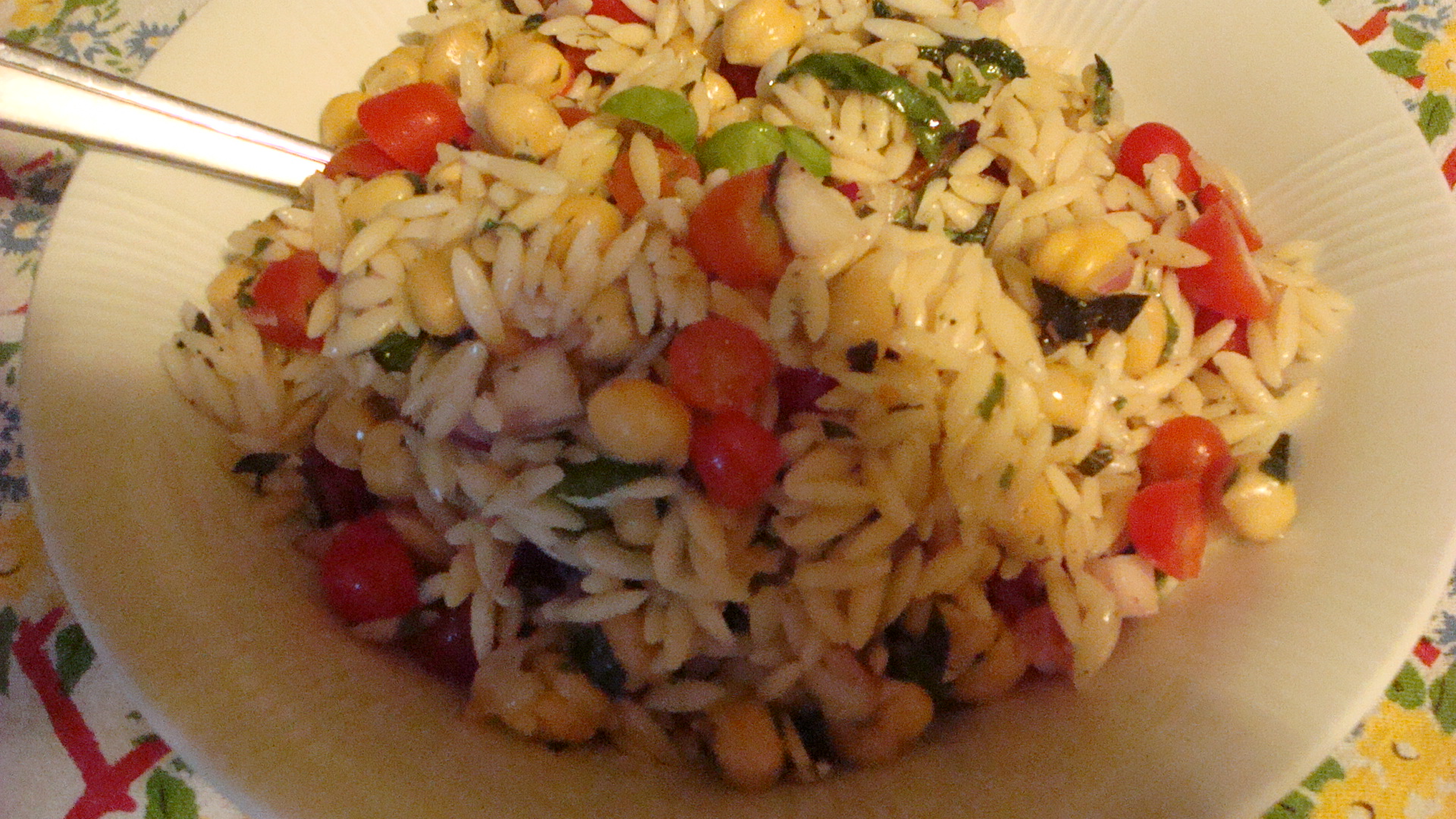
Orzo with Garbanzo Beans, Red Onion, Basil, and Mint
Rich Cocoa Cake
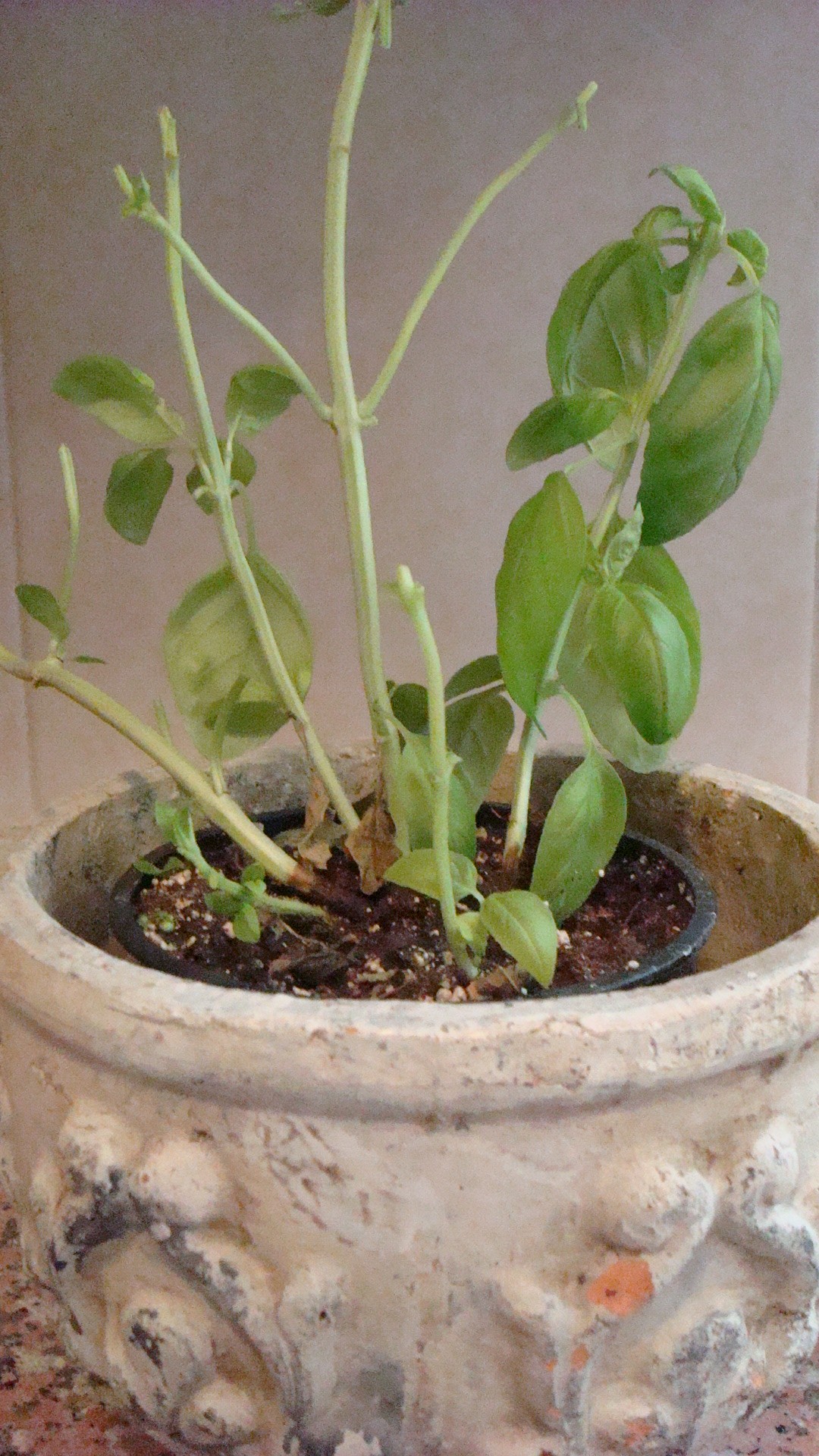
I went to Miles, the closest thing we have here to Balducci’s or Whole Foods, and bought most of the items off my list with the exception of sour cream (is it really that exotic?). I was able to find sour cream at another store and you would have thought that I bought gold! It was about $3 JD’s for an itty bitty little plastic container–the size of a container of sour cream that you get at Mexican restaurant. The only basil I could find was brown and spotty, but I bought it anyway to avoid having to go to another store this morning. When I looked at it this morning it was beyond repair and smelled terrible. As a result, I had to practically strip my sole living plant–a basil plant–of almost all of its leaves. There was no alternative though. The basil was rancid!
Practically 'naked' basil plant
Here’s the recipe for the Chicken:
2/3 cup EVOO
3 tbl plus 1/4 cup fresh lemon juice
1 1/2 tsp. fennel seeds (lightly crushed)
1 1/3 tsp. salt
1 tsp. freshly ground pepper
6 boneless, skinless breast halves
1 cup lightly packed basil leaves
1 large garlic clove
1 tsp. grated lemon zest
In a resealable plastic bag, combine 1/3 cup of the oil. 3 tbl. of the lemon juice, the fennel seeds, 3/4 tsp. of the salt, and 1/2 tsp. of the pepper. Add the chicken and seal the bag. Massage the marinade into the chicken. Refrigerate for at least 30 minutes and up to 24 hours, turning the chicken occasionally.
Meanwhile, in a blender, blend the basil, garlic, lemon zest, remaining 1/4 cup lemon juice, 3/4 tsp. salt, and 1/2 tsp. pepper until smooth. Gradually blend in the remaining 1/3 cup oil. Season with salt and pepper until smooth. Season the basil sauce to taste with more salt and pepper, if desired.
Prepare a grill for medium high heat (or a grill pan over medium high-heat). Grill the chicken until just cooked through, about 5 minutes per side. Transfer the chicken to a platter and drizzle with the basil sauce and serve.
The Pasta Salad:
4 cups water
1 1/2 cups orzo
1 (15 oz.) can garbanzo beans, drained and rinsed
1 1/2 cups mixed red and yellow teardrop tomatoes or grape tomatoes, halved
3/4 cup finely chopped red onion
1/2 cup chopped fresh basil
1/4 cup chopped fresh mint
3/4 cup red wine vinaigrette (below)
salt and pepper
Bring the water to a boil in a large, heavy sauce pan over high heat. Stir in the orzo. Cover partially and cook, stirring frequently, until the orzo is tender but still firm to the bite, about 7 minutes. Drain the orzo through a strainer. Transfer the orzo to a large, wide bowl and toss until the orzo cools slightly. Set aside to cool completely.
Toss the orzo with the beans, tomatoes, onion, basil, mint, and enough vinaigrette to coat; you may not need all 3/4 cup. Season the salad to taste with salt and pepper, and serve at room temperature.
For the vinaigrette:
1/2 cup red wine vinegar (* called red grape vinegar here–no drinking!!!)
1/4 cup fresh lemon juice
2 tsp. honey
2 tsp. salt
3/4 tsp. freshly ground black pepper
1 cup EVOO
Mix the vinegar, lemon juice, honey, salt, and pepper in a blender. With the machine running, gradually blend in the oil. Season with salt and pepper, if desired.
Rich Cocoa Cake:
1/2 cup cold water
2 tbl. (heaping) cocoa powder (I use Penzeys)
1 cup brown sugar
1 cup sugar
3 tbl. unsalted butter
2 eggs
1/2 tsp. salt
1 tsp. pure vanilla extract
1/2 cup sour cream
1/2 cup milk
1 tsp. baking soda
2 cups sifted flour
Icing:
1/3 cup unsalted butter, softened
1/3 cup cocoa powder
dash salt
6-8 cups powdered sugar (I only used about 3 cups)
1 tsp. pure vanilla extract
2-3 tbl. hot water
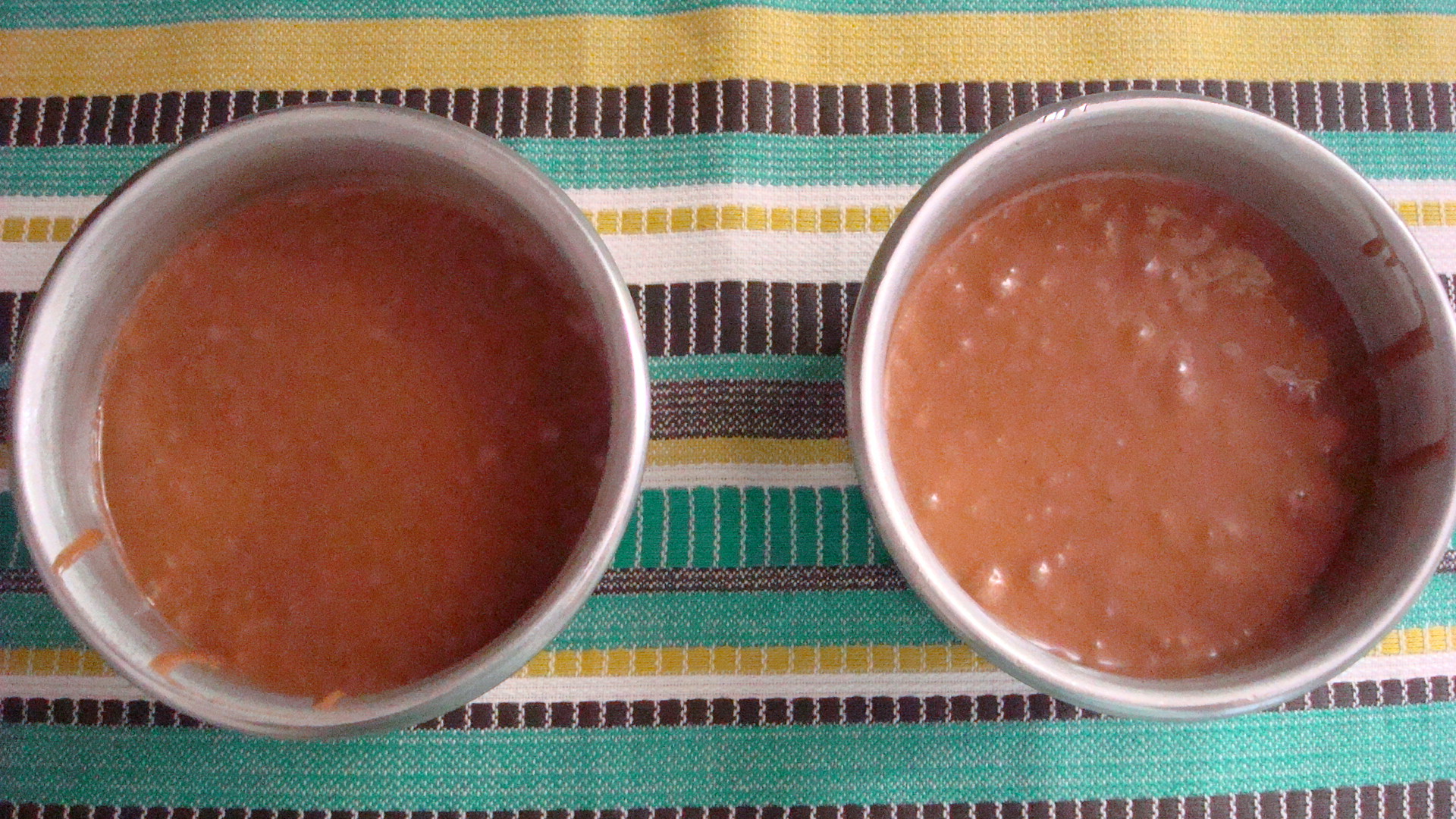
Preheat oven to 350 degrees. Lightly grease two 8-inch cake pans and set aside (I used 4×2 cake pans and it made 4 little cakes. I froze two for a later date). In a small saucepan, mix together the cold water and cocoa powder. Heat over medium, stirring constantly, until the mixture starts to boil. Remove from heat and set aside to cool. The mix should be paste-like. In a large mixing bowl, cream together the sugars and butter. Add the eggs, salt and vanilla extract and mix well. Add the cocoa mixture and beat well. In a small bowl, mix together the sour cream, milk and baking soda. Gradually add the sour cream mix to the batter, alternating with the flour. Beat well after each addition. Pour into pans and bake at 350 degrees for 22-26 minutes. Use a toothpick to test or note that the cake is fully risen and pulling away from the sides of the pan. Remove from the oven and let cool for a few minutes. Remove from the pans and let cool thoroughly before icing.
For the icing, cream together the butter and cocoa powder until fluffy. Add the salt. Gradually add the powdered sugar, beating well. Add the vanilla extract and mix well. Add just enough water to reach your desired consistency.
I realized yesterday that I’ve been here now for TWO months (and only have 20 months left of my sentence, j/k) and have cooked only a handful of meals. Why? I’ve determined this is for three reasons:
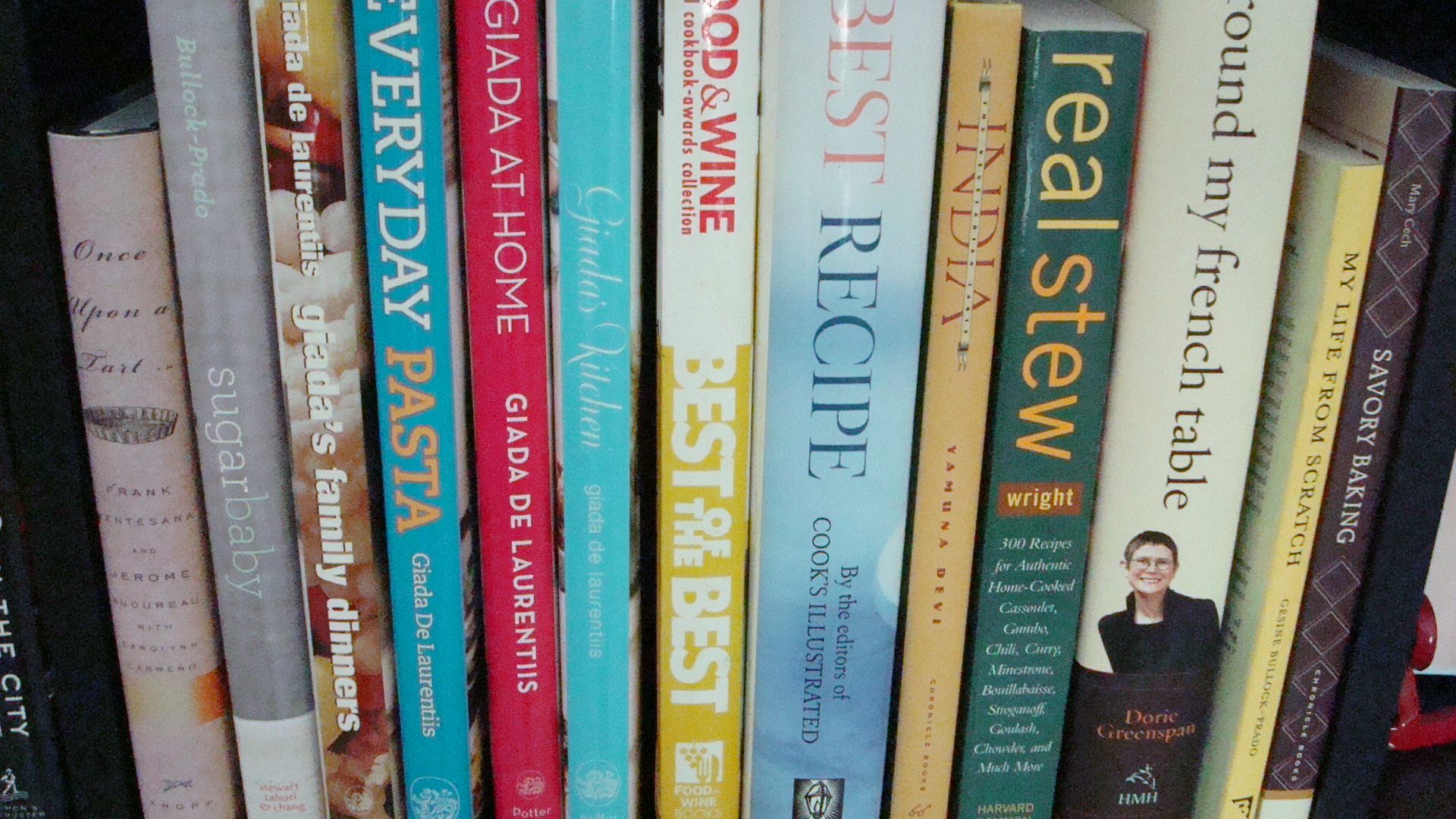
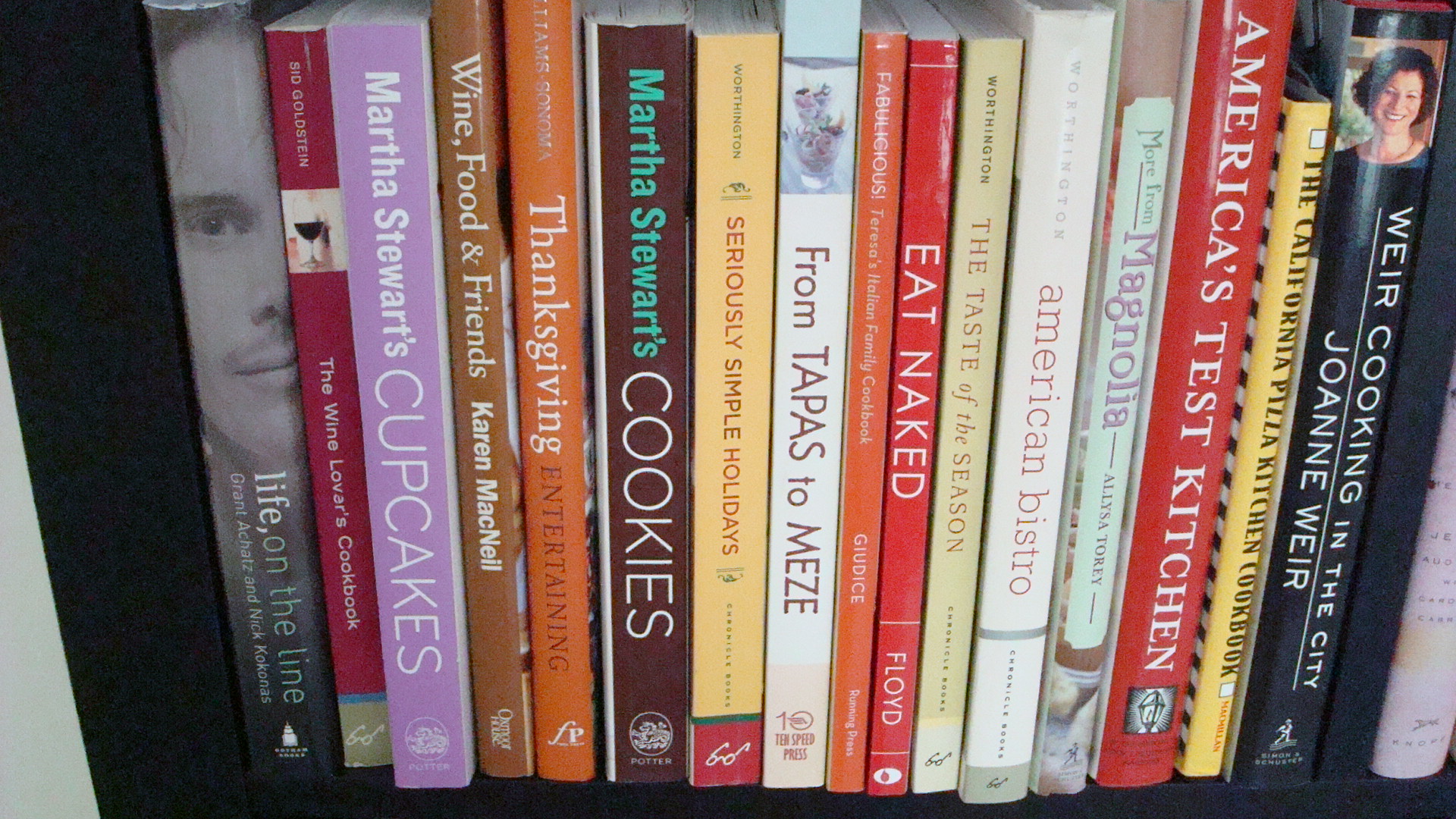
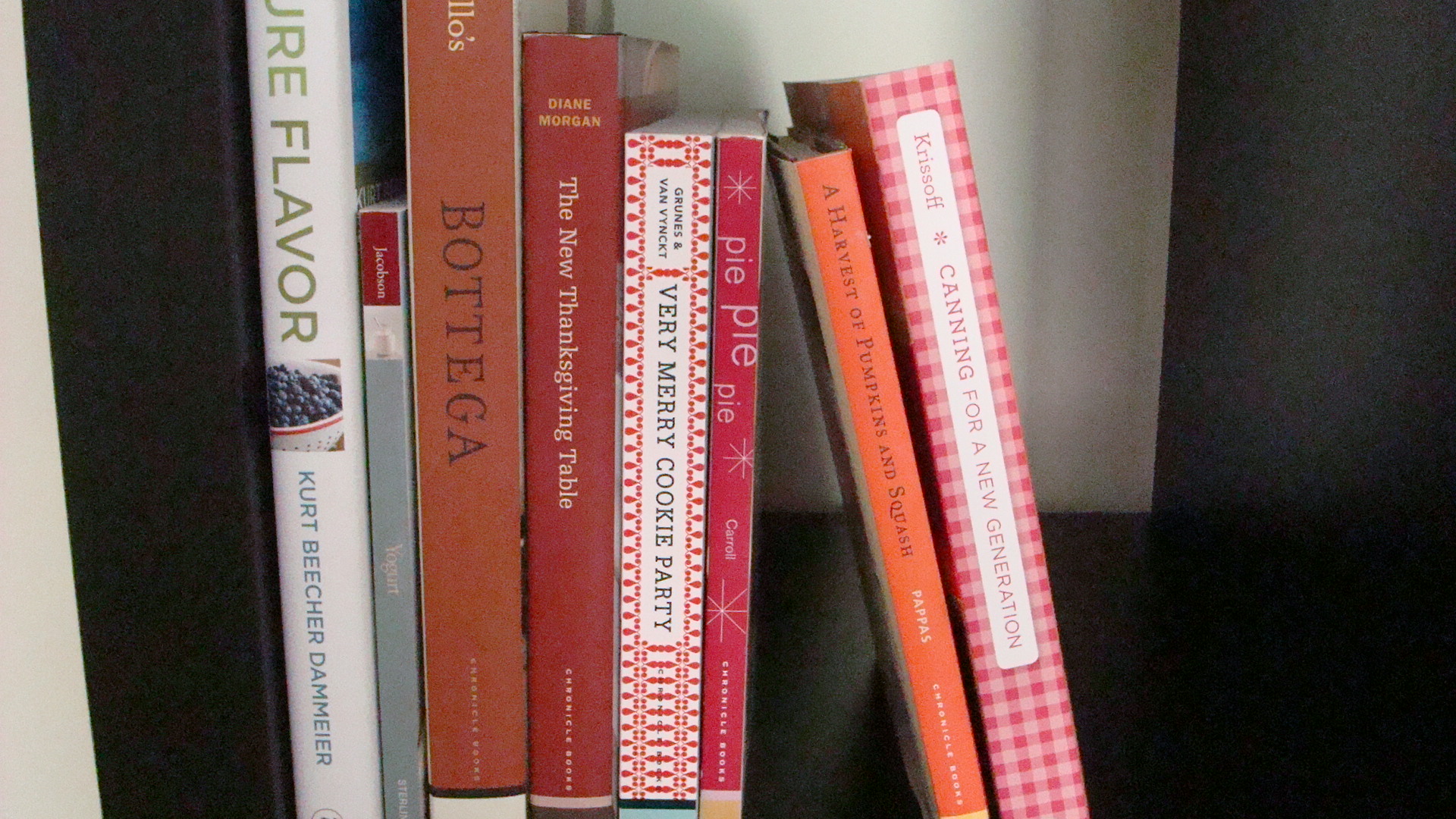
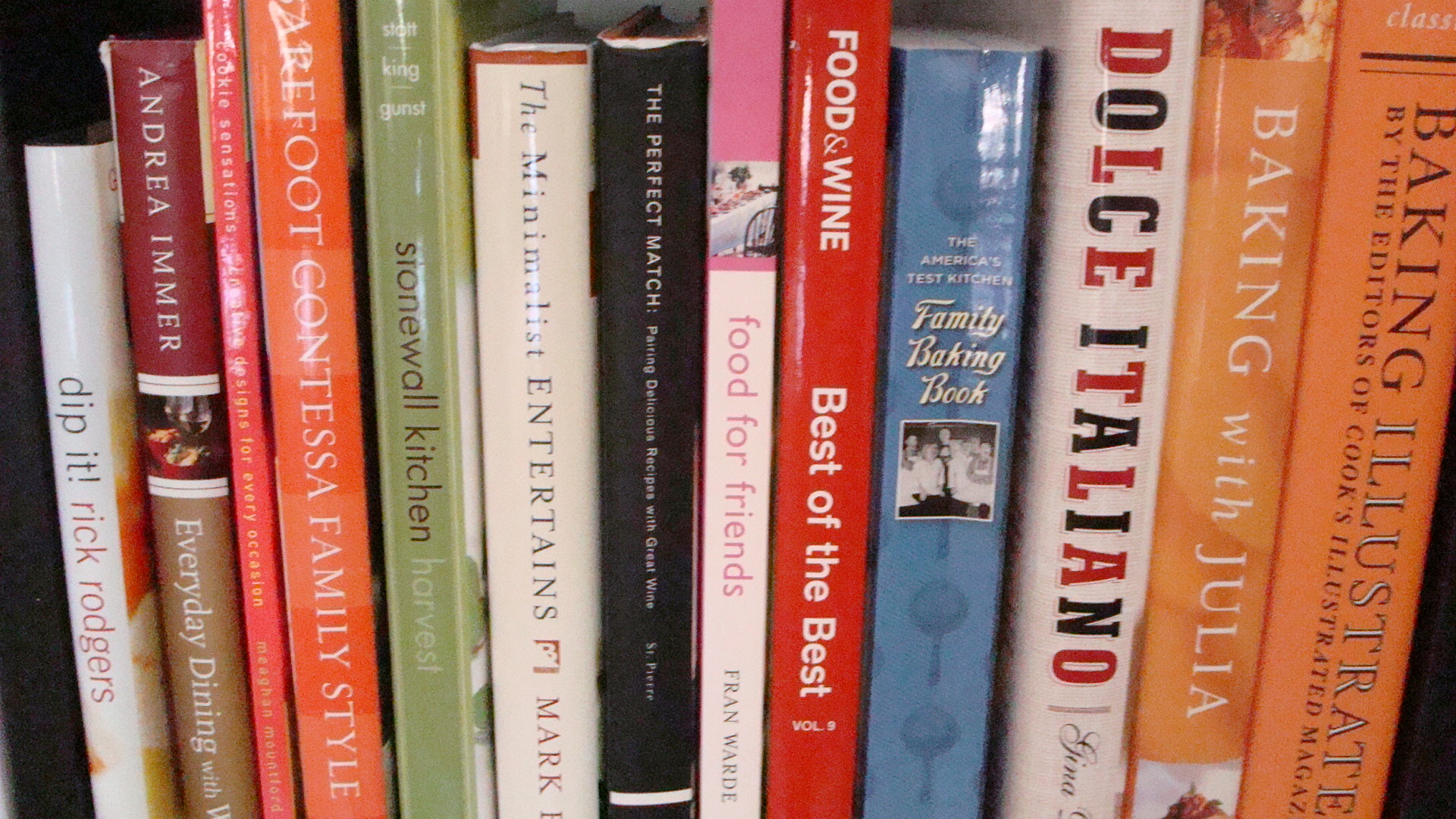
Firstly, Raj severely limited the number of cookbooks (ANY books for that matter) that I could bring with me. He scared me into thinking that my books would fall off of a container and into the water, never to be seen again (where is the water he was speaking of?). Back in February when I was struggling with which books to bring, Raj asked, “How would you feel if your signed books were lost, or stolen, or fell off a ship?” (Note: most of my books and cookbooks are signed by the authors and have been collected over years and Raj was playing on my sentimentality.) Can you believe this logic worked on me? (What’s worse, this logic worked for just about every item in the house, which is why there’s so little sense of home here.) I remember thinking that this all sounded logical, as if book bandits would be searching though our containers for autographed Brian Selznick books or Julia Child’s cookbooks. He had me so concerned that I agreed to his mandate, which limited me to TWO boxes, which is NOTHING and I’m realizing that I’m not very fond of many, strike that, ANY of the cookbooks that I’ve brought. (I’m making a case to buy more cookbooks.)
Here are what the contents of two boxes of cookbooks look like on my sad and lonely bookshelves.
Secondly, I HATE grocery shopping here! The stores aren’t that far away, but with the few cookbooks that I have, I can’t find the ingredients that I’m looking for. Yeah, I know, the solution is to improvise, explore the local foods, but I don’t feel like it…not now anyway. Further complicating matters right now is that it’s Ramadan for the entire month of August. What does this have to do with anything? Well, since everyone fasts all day, they feast at night and pillage the grocery store shelves leaving little by way of stock.
Lastly, as I’ve complained all along, my kitchen is not functional. I was making pizza dough last weekend and plugged in my Kitchen Aid to the electrical circuit, which is an extension cord that goes up to the converter box (you know the 1970s contraption that I had to hide from my line of sight?). (FYI, in case you’re worried, pizza night has not suffered. It’s still going strongly, every Friday, despite the cooking downturn.) As I was adjusting the speed, I kept feeling a tingling sensation. It took me a few more adjustments to realize I was getting shocked. Now, in order to use ANY of the small appliances that I brought, I have to disconnect everything in order to plug one thing in at a time. You’re thinking ‘what’s the big deal,’ right? The big deal is that the plugs are ALL above the cabinets so that I don’t have to see them. The issue is that unplugging everything requires me to get out the step-ladder, adjust the cords, re-hide the cords after I’m finished…it’s too much work. Did I mention that I’ve gained weight since I’ve gotten here too? Another reason not to cook!!!
So what’s my point? Long story long, I have a question to pose:
If you were moving abroad and were told that you could only bring ONE cookbook with you, which cookbook would it be and why?
When answering this, don’t take into account any of my gripes. Assume you don’t know what type of kitchen you’ll be cooking in and you’re not sure what types of food are available. Just choose your favorite, most indispensable cookbook and tell me why it’s so wonderful. Let’s see how many of your suggestions I’ll be placing in my next Amazon shopping cart.
Prior to arriving, my go to book was this one:
I still love this book, just not here. Most of the ingredients of my favorite recipes are nowhere to be found.
Yoga in Amman is like everything else here–DIFFERENT, not bad, not good & EXPENSIVE (no values here!). Let me preface this comparison by acknowledging how THANKFUL I am to have found a place to go to practice yoga. I won’t call it a yoga studio, but a fitness club that offers classes twice a week. Here’s the shakedown of how yoga at home differs from yoga in Amman.
Yoga at Home in Old Town, Alexandria:
I could WALK to the studio from my house, a short jaunt down a quaint street of historical, perfectly manicured homes, with GRASS, lots of dogs, cute boutiques and plenty of people out enjoying their day, regardless of the weather.
I’m welcomed into a peaceful, serene space that smells like lavender or incense.
I’m surrounded by like-minded people in fashionable, enviable yoga clothing–very unyogi-like , I know (that make me want to go home and order more Lululemon).
The instructors are NICE and COMPLIMENTARY (and fit!).
The music is hip and cool (similar to my musical tastes).
People speak and smile to each other and the studio offers tea and cookies.
Laughing is encouraged and practiced.
Instructors encourage you to move at your own pace.
You feel great after class: calm and collected.
Although yoga is expensive, you don’t mind because you feel like it’s a value for the benefits you receive.
Yoga in Amman:
I have to drive to the place (not a big deal, but driving here is DANGEROUS).
There is no welcome. You enter, walk down a staircase into the inner sanctum of the gym that smells like a gym.
No one wears yoga clothes.
I was told and even asked to demonstrate how I do a pose the wrong way (Did I mention that I’m a certified yoga instructor? No one else has ever pointed out that I don’t do chair pose correctly. Shame on you former teachers of mine!) She told me that I’ve formed a bad “habit” and have to fix it.
There is NO music! No sound, just the instructor’s voice.
No smiling, no talking, no treats after class.
No laughing allowed. This is very serious business.
We all do the same pose, regardless of our level. Apparently, we are ALL beginners, plus there are long breaks in between the poses (we only did THREE, one of which was mountain pose).
We practice Iyengar style yoga. Need I say more? Iyengar is a form of yoga, which I’m sure is fabulous, but extremely strict about alignment. I prefer vinyasa-style yoga, active, energetic classes where you feel like you’ve gotten a workout. After class I asked the teacher if this was a beginner yoga class and she told me it was a “mixed level” class. We did THREE poses in one hour and fifteen minutes and used chairs as props. God help me. Breathe! I also asked if she ever teaches vinyasa classes. She said, “No, ALL teachers in Amman teach Iyengar.”
I paid more per class than I do in DC.I expect to pay a lot in the land of milk and honey–it’s a big city with lots of options. Here in Amman there are NO options and the price should reflect this.
There you have it. Yoga in Amman is NOT fun or even fulfilling. I came home and did some more. Perhaps someday I’ll even learn to do chair pose correctly. Inshallah. Namaste.



































 Jen Maan in Amman