

Background Information
Okay, so maybe this wasn’t a pilgrimage for us, but it was a pretty incredible site to visit. According to the Bible, Moses received the Ten Commandments from God at this sight. The monastery was built by order of Emperor Justinian I (525-565), enclosing the Chapel of the Burning Bush ordered to be built by Helena, the mother of Constantine, at the site where Moses is supposed to have seen the burning bush (the living bush on the grounds is purportedly the original). This sight is said to be one of two of the oldest working Christian monasteries in the world (the other one, the monastery of St. Anthony, south of Cairo, is also on my list of places to visit).
Though this place is commonly known as Saint Catherine’s, the full, official name of the monastery is The Sacred and Imperial Monastery of the God-Trodden Mount of Sinai, and the patronal feast of the monastery is the Trasnfiguration. The site was associated with St. Catherine of Alexandria, a Christian martyr sentenced to death on the wheel. When this failed to kill her, she was beheaded. As the story goes, angels took her remains to Mount Sinai and around the year 800, monks from the Sinai Monastery found her remains on the top of Mt. Sinai and brought them into the chapel (you can see her coffin and a hand bone in a reliquary in the chapel).
A Fatimid mosque was built within the walls of the monastery, but it has never been used since it is not correctly oriented towards Mecca (you can still see the minaret next to the bell tower).
During the seventh century, the isolated Christian anchorites of the Sinai were eliminated: only the fortified monastery remained. The monastery is still surrounded by the massive fortifications that have preserved it. Until the twentieth century, access was through a door high in the outer walls (there’s a picture of it below). From the time of the First Crusade, the presence of Crusaders in the Sinai until 1270 spurred the interest of European Christians and increased the number of intrepid pilgrims who visited the monastery. The monastery was supported by its dependencies in Egypt, Palestine, Syria, Crete, Cyprus and Constantinople.
Getting There
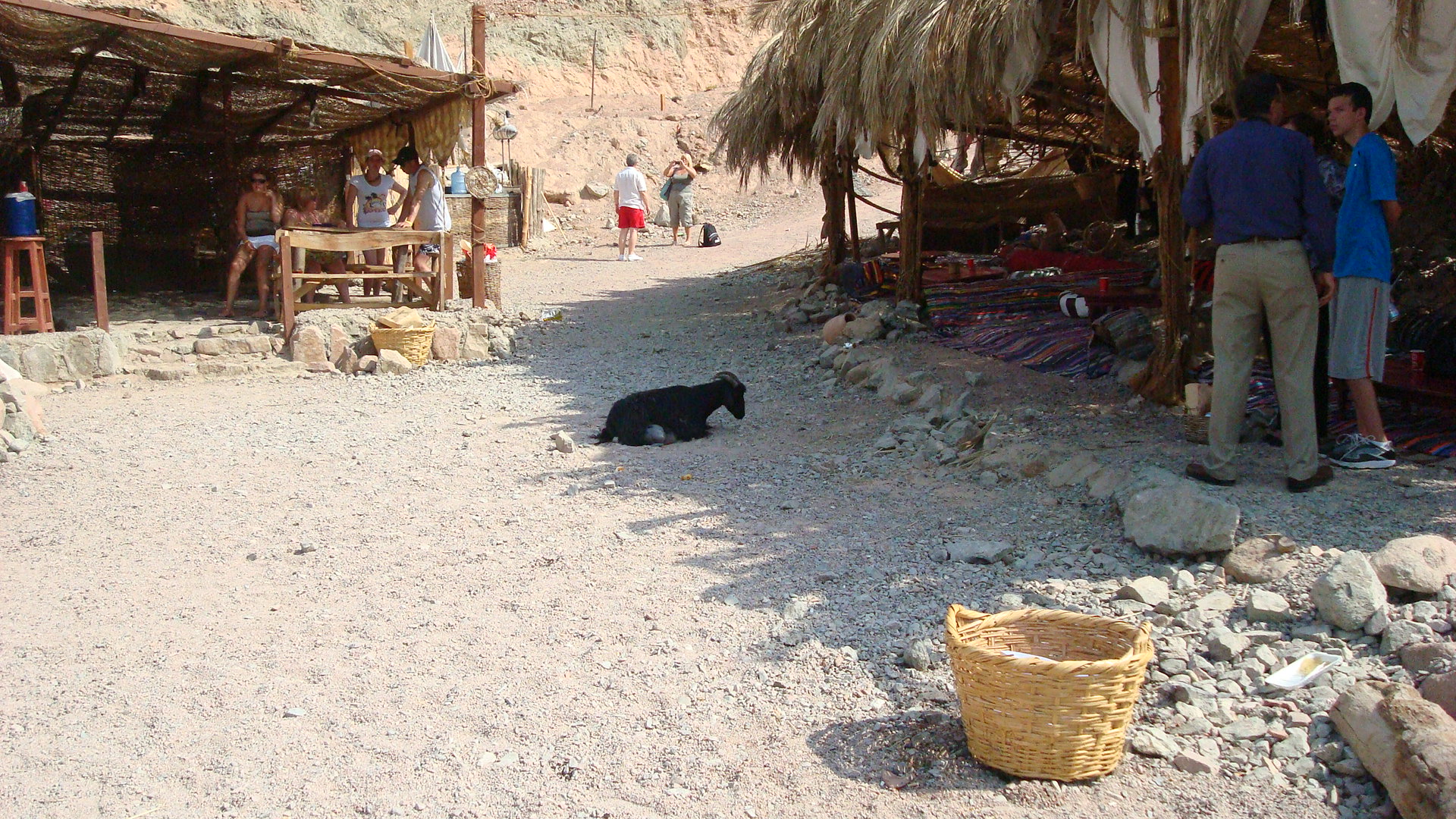
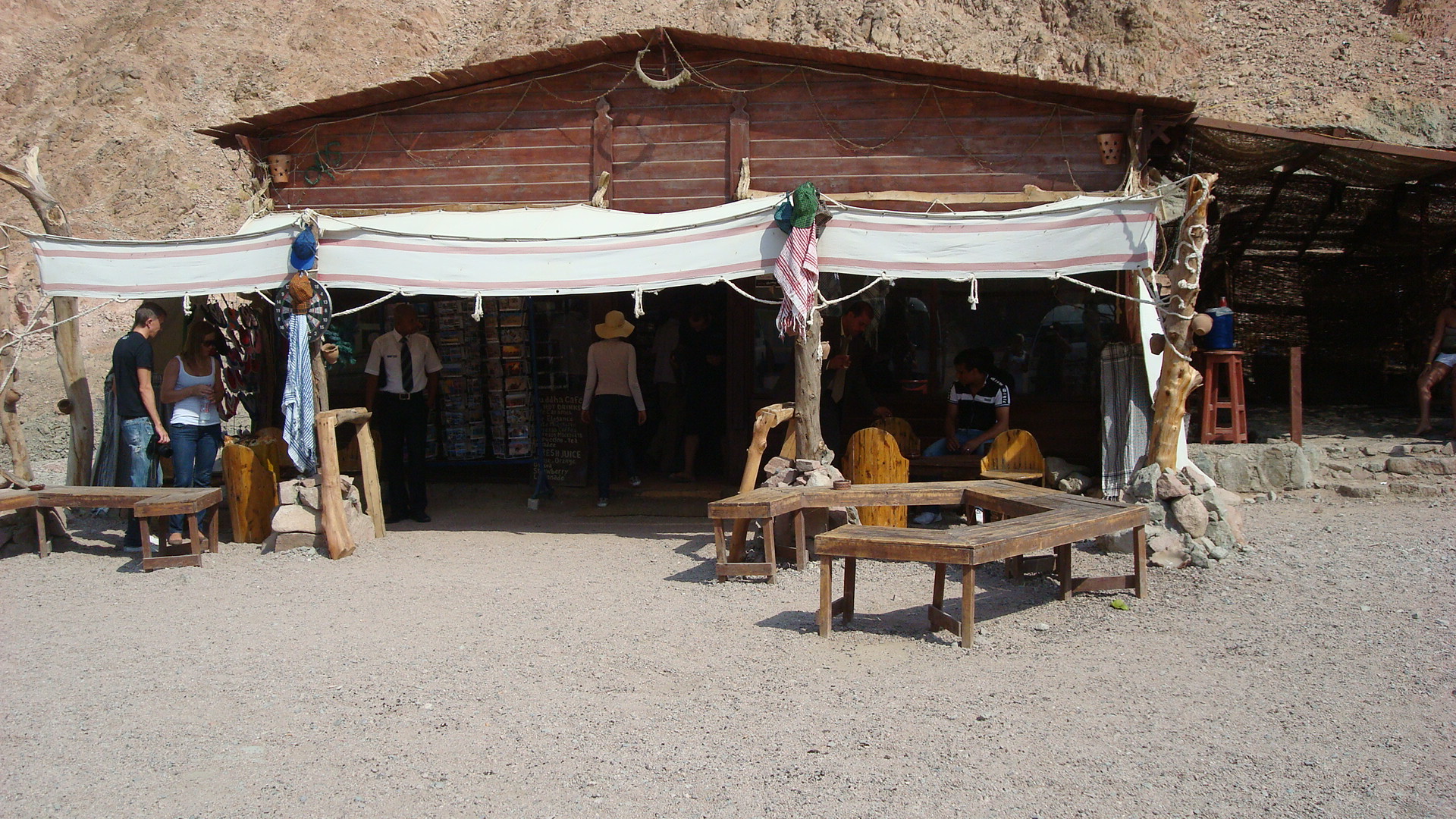
We were picked up again by the tour company very early in the morning. It takes about 3 hours to get to the city of St. Catherine’s and then about twenty more minutes to walk to the site. En route, we stopped for coffee and snacks at a roadside stand (thank God because we missed breakfast because it was so early and I was afraid that someone was going to get hangry again). Along the road, the landscape changed from barren looking desert to craggy mountains, similar to the Grand Canyon. There were lots of Bedouin camps in the middle of the inhospitable landscape too. Our guide was telling us the Bedouin’s don’t bury their animals remains, so there were lots of dead camels lying along the roadside.

The Pit
After what seemed like forever getting to the monastery, we parked in a parking lot and were led up a slight incline to the monastery’s entrance. Of course I was dressed inappropriately (as Raj always likes to point out) and was asked to place a scarf around my scantily clad legs. Our guide had forewarned us that there was no talking and no taking pictures inside the chapel. As we entered, it was dimly lit (to protect the icons) but it was extremely difficult to see them. We were given about five minutes to look around and then we were hurried out by the priests. As we exited, the burning bush was to our right. Even more exciting to me at this point on the trip was the WC (wash closet or bathroom) that I saw off in the distance (keep in mind the drive was over three hours long). I excused myself to visit the ‘facilities,’ but couldn’t go. It was a pit toilet. As much as I had to go, I couldn’t. I exited the bathroom telling myself I could hold it (but for how long?). This lasted about two minutes and then I resigned myself to try again. I walked back in, started dismantling my skirt-scarf, which I might add fell off and onto the the WET floor. (OMG, what was the wetness???). As I walked out again, I mentioned that the floor was WET to the woman in line behind me. She said it was just water from the hose. I went back in and there was NO HOSE…Yep, you know what it was and it was now on my scarf and I had to put the scarf back on my legs to cover them up. I went back in for a third time ready to get it over with when a woman from our group (a saint, really) came running in to tell me that the guide said our lunch place had a REAL toilet. I could hold for an hour knowing this and so I wrapped my pee scarf back on and headed out. Twenty minutes later, we were eating lunch in a restaurant and all was well.


Not happy about the scarf
Heading Back
On the way back towards Sharm el-Sheikh, we made one last stop in the coastal town of Dahab. We stopped at a jewelry store, made a couple of fabulous birthday purchases, and then walked along a promenade of shops. We were dropped off in the early evening, again exhausted from not much except sitting in a van all day. Next time we plan on doing the “Mt. Moses” tour (you’re picked up by the tour company at 10:00pm, brought to the base of the mountain (at St. Catherine’s), you climb for three hours, watch the sunrise (there are three coffee shops at the top of the mountain), then you walk down after sunrise and are driven back). We got back to our room and I was surprised to find a birthday cake waiting for me.
 Jen Maan in Amman